
Download 3000 từ vựng tiếng Anh thông dụng nhất PDF

Để giao tiếp tiếng Anh tốt, bạn nhất định cần có vốn từ vựng đa dạng và phong phú. Tuy nhiên, việc nâng cao vốn từ không thể đạt được trong một sớm một chiều mà đòi hỏi bạn phải kiên trì học và bổ sung từ vựng mỗi ngày.

Tài liệu gồm 3000 từ vựng tiếng Anh thông dụng nhất. Điểm khác biệt so với các tài liệu khác là phần định nghĩa (definition) được trích từ các nguồn uy tín như Cambridge Dictionary, hoàn toàn bằng tiếng Anh, kèm theo ví dụ cụ thể giúp bạn hiểu đúng ngữ cảnh sử dụng. Hy vọng tài liệu được đầu tư nhiều công sức này sẽ hữu ích cho bạn.

Tại sao cần học 3000 từ vựng tiếng Anh thông dụng?

Cơ sở giao tiếp:
3000 từ vựng thông dụng chiếm phần lớn các từ xuất hiện trong giao tiếp hằng ngày. Đây là những từ thường gặp trong hội thoại, đọc báo, xem truyền hình và nghe radio. Nắm vững chúng giúp bạn hiểu và phản hồi nhanh, chính xác trong các tình huống thực tế.

Đọc hiểu và nghe hiểu:
Khi sở hữu 3000 từ vựng cơ bản, bạn có thể hiểu phần lớn nội dung của các bài viết và cuộc hội thoại thông thường. Điều này giúp cải thiện đáng kể kỹ năng đọc và nghe, đồng thời dễ dàng tiếp cận các tài liệu học thuật và truyền thông bằng tiếng Anh.

Nền tảng vững chắc:
Việc học 3000 từ vựng thông dụng tạo nền tảng vững chắc để bạn tiếp tục học nâng cao. Khi đã có vốn từ cơ bản, bạn sẽ dễ dàng suy đoán nghĩa và hiểu ngữ cảnh của từ mới.

Lợi ích trong học tập và công việc:
Trong môi trường học tập và làm việc, tiếng Anh là kỹ năng quan trọng. Nắm vững từ vựng thông dụng giúp bạn tiếp thu kiến thức nhanh hơn, theo kịp bài học và giao tiếp hiệu quả trong công việc, đặc biệt trong môi trường quốc tế.

Link toàn bộ  các bài:

P1: 0-500 từ

P2: 501-1000 từ

P3: 1001-1500 từ

P4: 1501-2000 từ

P5: 2001-2500 từ

P6: 2501-3000 từ

Để nghe phát âm chuẩn giọng bản xứ của 3000 từ vựng tiếng Anh, bạn chỉ cần dán danh sách từ vào từ điển trên Mp3english.com. Hệ thống cho phép nghe phát âm hàng trăm từ chỉ trong một lần tra, giúp tiết kiệm thời gian hơn so với việc tra cứu từng từ như các trang khác.
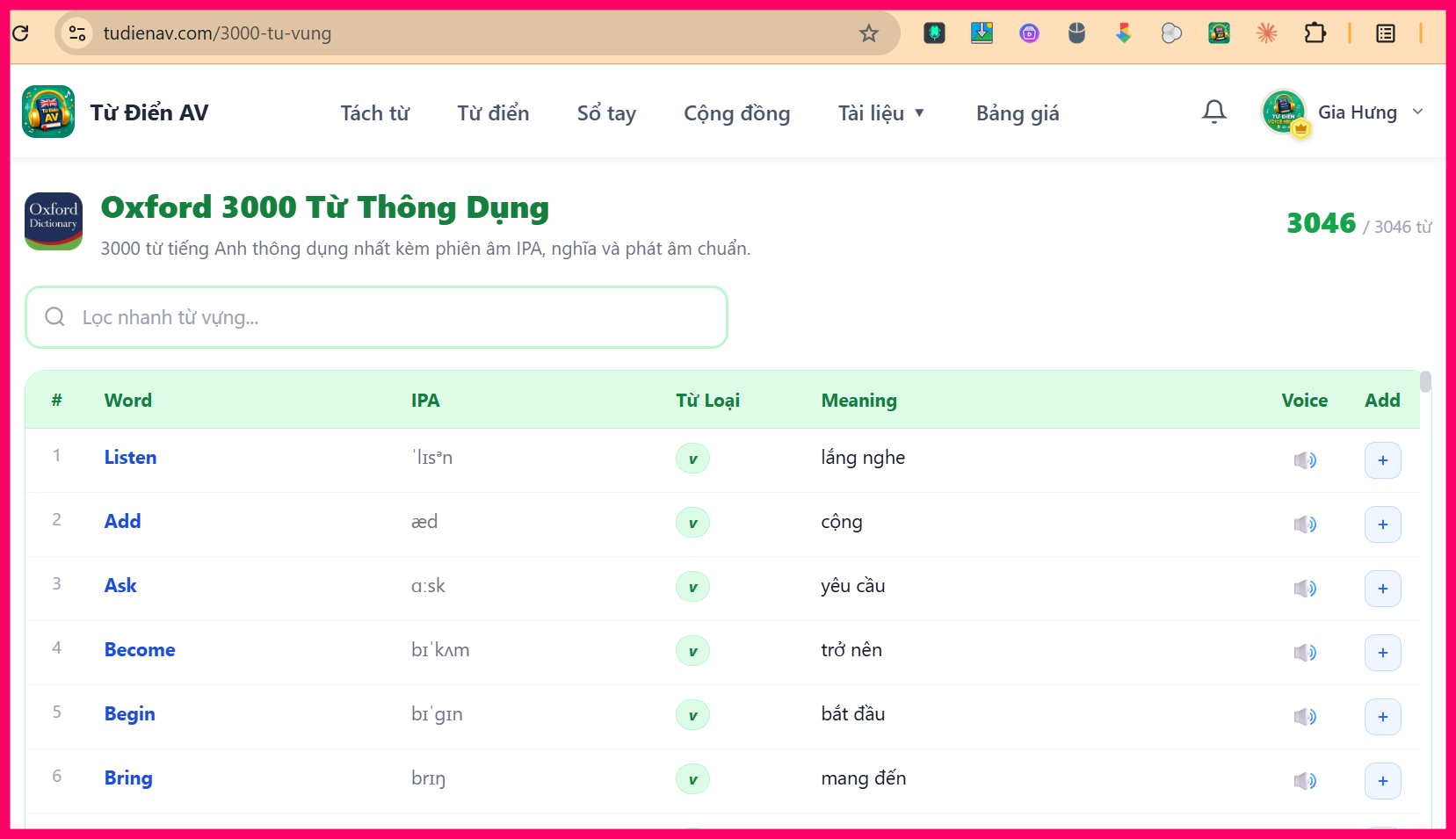
 

NO  TỪ VỰNG      NGHĨA TỪ LOẠI                                 ĐỊNH NGHĨA
1Listennghe, lắng nghev*to pay attention to somebody/something that you can hear
*used to tell somebody to take notice of what you are going to say

1. Listen! What's that noise? Can you hear it?
2. Listen, there's something I have to tell you
(lisn)
2Addcộng, thêm vàov*to put something together with something else so as to increase the size, number, amount, etc.
*to put numbers or amounts together to get a total

1. The juice contains no added sugar.
2. He knew how to add and subtract.
(æd)
3Askhỏiv*to say or write something in the form of a question, in order to get information
*to tell somebody that you would like them to do something or that you would like something to happen

1. There are three important questions to ask.
2. They were politely asked to leave the shop.
(ɑ:sk)
4Becometrở thành, trở nênv*linking verb to start to be something
*to be suitable for somebody

1. It is becoming increasingly clear that something has gone seriously wrong.
2. Such behaviour did not become her.
(bi'kʌm)
5Beginbắt đầu, khởi đầuv*to start doing something; to do the first part of something
*to start to happen or exist, especially from a particular time

1. Let's begin at page 9.
2. When does the concert begin?
(bi'gin)
6Bringmang, cầm , xách lạiv*to come to a place with somebody/something
*to give or provide somebody/something with something

1. Don't forget to bring your books with you.
2. We'll bring you the election results as soon as we have them.
(briɳ)
7Buildxây dựngv*to make something, especially a building, by putting parts together
*to create or develop something

1. We build computer systems for large companies.
2. It is important to build a network of like-minded colleagues.
(bild)
8Carrymang, vác, khuân chởv*to support the weight of somebody/something and take them or it from place to place; to take somebody/something from one place to another
* to have something with you and take it wherever you go

1. The plane was carrying 122 passengers and five crew.
2. Police in many countries carry guns.
(ˈkæri)
9Comeđến, tới, đi đến, đi tớiv*to move to or towards a person or place
*to arrive at or reach a place

1. He came into the room and shut the door.
2. She came to work wearing a very smart suit.
(kʌm)
10Diechết, tư trần, hy sinhv*to stop living
*to stop existing; to disappear

1. My father died suddenly at the age of 48.
2. The old customs are dying.
(daɪ)
11Enjoythưởng thức, thích thú cái gìv*to get pleasure from something
*to be happy and get pleasure from what you are doing

1. Thanks for a great evening. I really enjoyed it.
2. They all enjoyed themselves at the party.
(in'dЗoi)
12Enterđi vào, gia nhậpv*to come or go into something
*to put your name on the list for an exam, a race, a competition, etc.; to do this for somebody

1. Someone entered the room behind me.
2. Over a thousand children entered the competition.
(́entə)
13Feelcảm thấyv*linking verb to experience a particular feeling or emotion
*to notice or be aware of something because it is touching you or having a physical effect on you

1. The bus ride made me feel sick.
2. She felt a sharp pain in her hand.
(fi:l)
14Findtìm, tìm thấyv*to discover somebody/something unexpectedly or by chance
* to get back something/somebody that was lost after searching for it/them

1. We've found a great new restaurant near the office.
2. I thought I'd lost my wallet but I found it under my desk.
(faind)
15Follow*đi theo sau, theo, 
*theo dõi
v*to come or go after or behind somebody/something
*to come or go after or behind somebody in order to watch where they go and what they do

1. He followed her into the house.
2. I think we're being followed.
(fɔlou)
16Forgetquênv*to not remember to do something that you ought to do, or to bring or buy something that you ought to bring or buy
*to be unable to remember something that has happened in the past or information that you knew in the past

1. In the excitement I forgot all about my little brother.
2. I'd completely forgotten about the money he owed me.
(fə'get)
17Foundtìm, tìm thấyv* to start something, such as an organization or an institution, especially by providing money
*to be the first to start building and living in a town or country

1. Her family founded the college in 1895.
2. The town was founded by English settlers in 1790.
(faund)
18Getđược, có đượcv* to receive something
*to obtain something

1. This room gets very little sunshine.
2. He has just got a new job.
(get)
19Givecho, biếu, tặngv* to hand something to somebody so that they can look at it, use it or keep it for a time
*to hand something to somebody as a present; to allow somebody to have something as a present

1. Give the letter to your mother when you've read it.
2. She was given a huge bunch of flowers.
(giv)
20Gođiv*to move or travel from one place to another
*to move or travel, especially with somebody else, to a particular place or in order to be present at an event

1. She went into her room and shut the door behind her.
2. Are you going to Dave's party?
(gou)
21Growmọc, mọc lên. lớn lên, trưởng thànhv* to increase in size, number, strength or quality
*to become bigger or taller and develop into an adult

1. Opposition to the latest proposals is growing steadily.
2. You've grown since the last time I saw you!
(grou)
22Happenxảy ra, xảy đếnv* to take place, especially without being planned
*to take place as the result of something

1. You'll never guess what's happened!
2. She pressed the button but nothing happened.
(hæpən)
23Hearnghev*to be aware of sounds with your ears
*to listen or pay attention to somebody/something

1. She could hear voices in the kitchen.
2. He knows that the crowd wants to hear those songs.
(hiə)
24Keepgiữ, giữ lạiv* to continue to have something and not give it back or throw it away
* to put or store something in a particular place

1. She handed the waiter a hundred dollar bill and told him to keep the change.
2. Keep your passport in a safe place.
(ki:p)
25Knowbiếtv*to have information in your mind as a result of experience or because you have learned or been told it
*to realize, understand or be aware of something

1. We know from experience that turning a hobby into a business is not easy.
2. As soon as I walked in the room I knew (that) something was wrong.
(nou)
26Learnhọc, nghiên cứuv*to gain knowledge or skill by studying, from experience, from being taught, etc.
*to study and repeat something in order to be able to remember it

1. You can learn a great deal just from watching other players
2. We have to learn one of Hamlet's speeches for school tomorrow
(lə:n)
27Letcho phép, để chov*used for making suggestions or as a polite way of telling people what you want them to do
*used for making requests or giving instructions

1. Let's not tell her what we did
2. Let me have your report by Friday
(lεt)
28Meannghĩa, có nghĩa làv*to have something as a meaning in the same or another language
*to have something as a meaning; to represent something

1. The word ‘Kuching’ means ‘cat’ in Malay
2. What do we mean by democracy
(mi:n)
29Readđọcv*to look at and understand the meaning of written or printed words or symbols
*to go through written or printed words, etc. in silence or speaking them to other people

1. Can you read music?
2. I'm going to go to bed and read
(ri:d)
30Repeatnhắc lại, lặp lạiv*to say or write something again or more than once
*used to emphasize something that you have already said

1. to repeat a question/a claim/an assertion/a warning
2. I am not, repeat not, travelling in the same car as him!
(ri'pi:t)
31Savecứu, lưuv*to keep somebody/something safe from death, harm, loss, etc
* to keep money instead of spending it, especially in order to buy a particular thing

1. She needs to win the next two games to save the match
2. I'm not very good at saving
(seiv)
32Saynóiv*to speak or tell somebody something, using words
* to repeat words, phrases, etc.

1. That was marvellous,’ said Daniel.
2. Try to say that line with more conviction
(sei)
33Seenhìn, nhìn thấy, quan sátv*to become aware of somebody/something by using your eyes
*to have or use the power of sight

1. I looked out of the window but saw nothing
2. She will never see again
(si:)
34Sendgửi, phái điv*to make something go or be taken to a place, especially by post, email, radio, etc.
*to tell somebody something by sending them a message

1. I sent the package by airmail
2. Henry sent his regards to you
(send)
35Singhát, ca hátv*an act of singing


1. Let's have a sing
2. the beautiful singing of birds
(siɳ)
36Sitngồiv*to rest your weight on your bottom with your back straight, for example on/in a chair
*to put somebody in a sitting position

1. She sat and stared at the letter in front of her.
2. He lifted the child and sat her on the wall.
(sit)
37Suckbú, hútv* to take liquid, air, etc. into your mouth by using the muscles of your lips
*to keep something in your mouth and pull on it with your lips and tongue

1. to suck the juice from an orange
2. He sucked at the wound on his hand
(sʌk)
38Swimbơi lộiv* to move through water by moving your arms and legs, without touching the bottom
*to spend time swimming for pleasure

1. The boys swam across the lake
2. We always went swimming together in our indoor pool
(swim)
39SwellSưng, phồng lênv*to become bigger or rounder
*to go out or make something go out in a curved shape

1. Her arm was beginning to swell up where the bee had stung her.
2. His belly swelled out over his belt.
(́swoulən, swel)
40Takesự cầm nắm, sự lấyv*to carry or move something from one place to another
*to go with somebody from one place to another, especially to guide or lead them

1. You need to take your laptop to the technician
2. I'm taking the kids swimming later
(teik)
41Teachdạyv*to give lessons to students in a school, college, university, etc.; to help somebody learn something by giving information about it
*to show somebody how to do something so that they will be able to do it themselves

1. I'll be teaching history and sociology next term
2. Could you teach me to do that?
(ti:tʃ)
42Tellnói, nói vớiv*to give information to somebody by speaking or writing
*to give information about something

1. He told the news to everybody he saw.
2. This gauge tells you how much fuel you have left
(tel)
43Thankcám ơnv*to tell somebody that you are grateful for something


1. I must write and thank Mary for the present
2. She said goodbye and thanked us for coming
(θæŋk)
44Thinknghĩ, suy nghĩv*to have a particular idea or opinion about something/somebody; to believe something
*to use your mind to consider something, to form connected ideas, to try to solve problems, etc

1. I think this is their house, but I'm not sure
2.Stop and think for a moment before making any decisions
(θiŋk)
45Trythử, cố gắngv* to make an attempt or effort to do or get something
*to use, do or test something in order to see if it is good, suitable, etc.

1. I don't know if I can come but I'll try
2. I'm having a caffeine-free week. You should try it
(trai)
46Winchiến thắngv* to be the most successful in a competition, race, battle, etc.
*to get something as the result of a competition, race, election, etc.

1. She loves to win an argument
2. How many states did the Republicans win?
(win)
47Windgió, đầy hơi bụngv*air that moves quickly as a result of natural forces
*air that you swallow with food or drink; gas that is produced in your stomach or intestines that makes you feel uncomfortable

1. The trees were swaying in the wind
2. I can't eat beans—they give me wind.
(wind)
48Writeviếtv*to make letters or numbers on a surface, especially using a pen or a pencil
*to produce something in written form so that people can read, perform or use it, etc.

1. I haven't got anything to write with.
2. I wanted to travel and then write about it
(rait)
49Fithợp, vừav, adj*to be the right shape and size for somebody/something
*to be of the right size, type or number to go somewhere

1. I tried the dress on but it didn't fit.
2. I'd like to have a desk in the room but it won't fit.
(fit)
50Maycó thể, có lẽv, modal*used to say that something is possible
*used to ask for or give permission

1. That may or may not be true.
2. You may come in if you wish
(mei)
51Mustphải, cần, nên làmv, modal* used to say that something is necessary or very important
*used to say that something is likely or logical

1. All visitors must report to reception
2. You must be hungry after all that walking
(mʌst)
52Shouldnênv, modal*used to show what is right, appropriate, etc., especially when criticizing somebody’s actions
*used for giving or asking for advice

1. You shouldn't drink and drive
2. Should I call him and apologize?
(ʃud, ʃəd, ʃd)
53Wouldsẽv, modal*used in polite offers or invitations
*used to say what you like, love, hate, etc.

1. Would you have dinner with me on Friday
2. I'd be only too glad to help
(wud)
54Needcần, đòi hỏi; sự cầnv, modal verb, n*to require something/somebody because they are essential or very important, not just because you would like to have them
* used to show what you should or have to do

1. It's here if you need it
2. All you need to do is complete this form
(ni:d)
55Callgọi điện, đặt tênv, n*to give somebody/something a particular name; to use a particular name or title when you are talking to somebody
*to phone somebody

1. They decided to call the baby Mark.
2. I'll call again later.
(kɔ:l)
56Changethay đổi, biến đổiv, n*to become different
*to make somebody/something different

1. We examined changing attitudes towards education.
2. That experience changed my life.
(tʃeɪndʒ)
57Chatnói chuyện, tán gẫuv, n* to talk in a friendly, informal way to somebody
*to exchange messages with somebody on the internet, when you can see and reply to messages immediately and have a written conversation

1. I'm sorry I can't stop to chat.
2. I've been chatting online with my best friend.
(tʃæt)
58Checkkiểm tra; sự kiểm trav, n*to examine something to see if it is correct, safe or acceptable
*to look at something or ask somebody to find out if something/somebody is present, correct or true or if something is how you think it is

1. Check the oil and water before setting off.
2. We'll check back in a couple of hours.
(tʃek)
59Clicklàm thành tiếng lách cách, cú nhắp (chuột)v, n*to choose a particular function or item on a computer screen, etc., by pressing one of the buttons on a mouse or touchpad
*to make or cause something to make a short sharp sound

1. Click here to add your opinion to the survey.
2. The cameras clicked away.
(klik)
60Cooknấu ănv, n* to prepare food by heating it, for example by boiling, baking or frying it
* to be prepared by boiling, baking, frying, etc.

1. Add the onion and cook for three minutes.
2. While the pasta is cooking, prepare the sauce.
(kʊk)
61Crykhócv, n*to produce tears from your eyes because you are unhappy or hurt
*to shout loudly

1. I just couldn't stop crying.
2. She ran to the window and cried for help.
(krai)
62Cutcắtv, n*to make an opening or a wound in something, especially with a sharp tool such as a knife or scissors
*to divide something into two or more pieces with a knife, etc.

1. She cut her finger on a piece of glass.
2. The bus was cut in two by the train.
(kʌt)
63Hateghét, thù hậnv, n*to dislike somebody/something very much
*used when saying something that you would prefer not to have to say, or when politely asking to do something

1. He was her most hated enemy.
2. I hate to say it, but I don't think their marriage will last.
(heit)
64Helpgiúp đỡ; sự giúp đỡv, n* to make it easier or possible for somebody to do something by doing something for them or by giving them something that they need
*to improve a situation; to make it easier for something to happen

1. He always helps with the housework.
2. The support of our families has helped enormously.
(help)
65Hitđánhv, n*to bring your hand, or an object you are holding, against somebody/something quickly and with force
*to come against something/somebody with force, especially causing damage or injury

1. I was afraid he was going to hit me.
2. The boy was hit by a speeding car.
(hit)
66Hurrysự vội vàng, sự vội vàngv, n*to move or act quickly because there is not much time
* to move quickly in a particular direction

1. You'll have to hurry if you want to catch that train.
2. He picked up his bags and hurried across the courtyard.
(hɜri , hʌri)
67Kisshôn, cái hônv, n*to touch somebody with your lips as a sign of love or sexual desire or when saying hello or goodbye
*to gently move or touch something

1. They stood in a doorway kissing
2. The sunlight kissed the warm stones.
(kis)
68Lienói dối; lời nói dối, sự dối tráv, n*to be or put yourself in a flat position so that you are not standing or sitting
*to be or remain in a flat position on a surface

1. The cat was lying fast asleep by the fire
2. She picked up a pen that was lying nearby
(lai)
69Lockkhóa; ổ khóav, n*to fasten something with a lock; to be fastened with a lock
*to put something in a safe place and lock it

1. David locked the car and slipped the key into his pocket
2. She locked her passport and money in the safe
(lɔk)
70Looknhìn; cái nhìnv, n*to turn your eyes in a particular direction
*to pay attention to something

1. Look! I'm sure that's Jennifer Lawrence!
2. Look at the time! We're going to be late
(luk)
71Makelàm, chế tạov, n*to create or prepare something by combining materials or putting parts together
*to write, create or prepare something

1. She makes her own clothes
2. My lawyer has been urging me to make a will
(meik)
72Missbỏ lỡ, trượtv, n*to be or arrive too late for something
*to fail to do something

1. If I don't leave now I'll miss my plane
2. You can't afford to miss meals
(mis)
73Movedi chuyển, chuyển động; sự di chuyển, sự chuyển độngv, n* to change position or make somebody/something change position in a way that can be seen, heard or felt
*to change the place where you live, have your work, etc

1. The bus was already moving when I jumped onto it
2. We don't like it here so we've decided to move
(mu:v)
74Playchơi, đánh; sự vui chơi, trò chơi, trận đấuv, n*to do things for pleasure, as children do; to enjoy yourself, rather than work
*to pretend to be or do something for fun

1. You'll have to play inside today
2. They were playing at being cowboys
(plei)
75Reportbáo cáo, tường trình; bản báo cáo, bản tường trìnhv, n*a written or spoken account of an event, especially one that is published or broadcast
*a spoken or written description of something containing information that somebody needs to have

1. And now over to Jim Muir, for a report on the South African election
2. Can you give us a progress report?
(ri'pɔ:t)
76Runchạy; sự chạyv, n* to move using your legs, going faster than when you walk
*to travel a particular distance by running

1.Can you run as fast as Mike?
2. I ran four miles today
(rʌn)
77Showbiểu diễn, trưng bày; sự biểu diễn sự bày tỏv, n*to make something clear; to prove something
*to let somebody see something

1. His new book shows him to be a first-rate storyteller
2. If there's a letter from France please show it to me
(ʃou)
78Sleepngủ; giấc ngủv, n* to rest with your eyes closed and your mind and body not active
*to have enough beds for a particular number of people

1. I had to sleep on the sofa
2. The apartment sleeps six.
(sli:p)
79Standđứng, sự đứngv, n*to be on your feet; to be in a vertical position
*to get up onto your feet from another position

1. I was standing only a few feet away
2. I tried to stand up and found myself in agony
(stænd)
80Startbắt đầu, khởi động; sự bắt đầu, sự khởi đầu, khởi hànhv, n*to begin doing or using something
*to begin happening; to make something begin happening

1. Mistakes were starting to creep in
2. Have you any idea where the rumour started?
(stɑ:t)
81Stopdừng, ngưng, nghỉ, thôi; sự dừng, sự ngưng, sự đỗ lạiv, n*to no longer move; to make somebody/something no longer move
*to no longer continue to do something; to make somebody/something no longer do something

1. The car stopped at the traffic lights
2. Don't you ever stop talking?
(stɔp)
82Talknói chuyện, trò chuyện; cuộc trò chuyện, cuộc thảo luậnv, n*to say things; to speak in order to give information or to express ideas or feelings
* to discuss something, usually something serious or important

1. Who were you talking to just now?
2. Is there anything you'd like to talk about?
(tɔ:k)
83Turnquay, xoay, vặn; sự quay, vòng quayv, n* to move or make something move around a central point
*to move your body or part of your body so as to face or start moving in a different direction

1. The wheels of the car began to turn.
2. She turned to look at me
(tə:n)
84Wishước, mong muốn; sự mong ước, lòng mong muốnv, n*to want something to happen or to be true even though it is unlikely or impossible
*to want to do something; to want something to happen

1. I wish you wouldn't leave your clothes all over the floor
2. This course is designed for people wishing to update their computer skills
(wi∫)
85Worklàm việc, sự làm việcv, n*to do something that involves physical or mental effort, especially as part of a job
*to have a job

1. He is working on a new novel
2. I've always worked in education
(wɜ:k)
86Worrylo lắng, suy nghĩ; sự lo lắng, suy nghĩv, n*to keep thinking about unpleasant things that might happen or about problems that you have
*to make somebody/yourself anxious about somebody/something

1. We have plenty of time
2. Don't worry yourself about it—I'll deal with it.
(wʌri)
87Willsẽ; ý chí, ý địnhv, n, modal*to want or like


1. Call it what you will, it's still a problem

(wil)
88Dolàmvauxiliary, v*used to refer to actions that you do not mention by name or do not know about
*to act or behave in the way mentioned

1. What are you doing this evening?
2. They are free to do as they please.
(du:, du)
89Havevauxiliary, v*to own, hold or possess something
*be made up of

1. He had a new car and a boat.
2. In 2018 the party had 10 000 members.
(hæv, həv)
90Answersự trả lời; trả lờin, v*something that you say, write or do to react to a question or situation
*something that you write or say in reply to a question in a test, an exam, an exercise, etc.; the correct reply to a question in a test, etc.

1. I rang the bell, but there was no answer.
2. Write your answers on the sheet provided.
(ɑ:nsə)
91Caresự chăm sóc, chăm nom; chăm sócn, v* the process of caring for somebody/something and providing what they need for their health or protection
*the fact of providing a home in an institution run by the local authority or with another family for children who cannot live with their parents

1. We aim to continually improve the quality of patient care.
2. The two girls were taken into care after their parents were killed.
(kɛər)
92Copybản sao; sự sao chép; sao chép, bắt chướcn, v* a thing that is made to be the same as something else, especially a document or a work of art
*a single example of a book, newspaper, etc. of which many have been made

1. The thieves replaced the original painting with a copy.
2. The book sold 20 000 copies within two weeks.
(kɔpi)
93Dancesự nhảy múa, sự khiêu vũ; nhảy múa, khiêu vũn, v*a series of movements and steps that are usually performed to music; a particular example of these movements and steps
*the art of dancing, especially for entertainment

1. Do you know any other Latin American dances?
2. an evening of drama, music and dance
(dɑ:ns)
94Datengày, kỳ, kỳ hạn, thời kỳ, thời đạin, v*a particular day of the month, sometimes in a particular year, given in numbers and words
* a particular day or year when a particular event happened or will happen

1. They haven't set a date for the wedding yet.
2. I hated history at school—I could never remember all those dates.
(deit)
95Drinkđồ uống; uốngn, v*a liquid for drinking; an amount of a liquid that you drink
*alcohol or an alcoholic drink; something that you drink on a social occasion

1. Do you want a drink?
2. They went for a drink together.
(driɳk)
96Facekhuôn mặt; đương đầu, đối phó đối mặtn, v*the front part of the head, where the eyes, nose and mouth are
*an expression that is shown on somebody’s face

1. He buried his face in his hands.
2. I could tell by his face it hadn't gone well.
(feis)
97Filmdàn dựng, phim ảnhn, v*a series of moving pictures recorded with sound that tells a story, watched at a cinema or on a television or other device
*the art or business of making films

1. Let's stay in and watch a film.
2. She'd like to write for theatre and film.
(film)
98Fishcá, món cá; câu cá, bắt cán, v*a creature that lives in water, breathes through gills, and uses fins and a tail for swimming
*the soft part of fish that is eaten as food

1. They caught several fish.
2. The chef's fish dishes are his speciality.
(fɪʃ)
99Handtay, bàn tay; trao tay, truyền chon, v*the part of the body at the end of the arm, including the fingers and thumb
*using the hand or number of hands mentioned

1. Keep both hands on the steering wheel at all times.
2. a one-handed catch
(hænd)
100Headcái đầu; chỉ huy, lãnh đại, dẫn đầun, v*the part of the body on top of the neck containing the eyes, nose, mouth and brain
*the mind or brain

1. She nodded her head in agreement.
2. I sometimes wonder what goes on in that head of yours.
(hed)
101Landđất, đất canh tác, đất đain, v*the surface of the earth that is not sea
*an area of ground, especially of a particular type or used for a particular purpose

1. The new project will reclaim the land from the sea.
2. Changes in land use can have significant effects on the local wildlife.
(lænd)
102Listdanh sách; ghi vào danh sáchn, v*a series of names, items, figures, etc., especially when they are written or printed


1. I'll add you to the email list
2. Is your name on the list?
(list)
103Lovetình yêu, lòng yêu thương; yêu, thíchn, v*a very strong feeling of liking and caring for somebody/something, especially a member of your family or a friend
*a strong feeling of romantic attraction for somebody

1. She has earned the love and respect of many people
2. She has been in and out of love many times
(lʌv)
104Nametên; đặt tên, gọi tênn, v*a word or words that a particular person, animal, place or thing is known by
*a reputation that somebody/something has; the opinion that people have about somebody/something

1. Are you changing your name when you get married?
2. She first made her name as a writer of children's books.
(neim)
105Placenơi, địa điểmn, v* a particular position, point or area
*a particular city, town, building, etc

1. I can't be in two places at once
2. I used to live in York and I'm still fond of the place
(pleis)
106Pointmũi nhọn, điểm, quan điểm; chấm (câu..)n, v*a thing that somebody says or writes giving their opinion or stating a fact
*the main or most important idea in something that is said or done

1. She made several interesting points in the article.
2. The point is you shouldn't have to wait so long to see a doctor.
(pɔɪnt)
107Replysự trả lời, sự hồi âm; trả lời, hồi âmn, v*to say or write something as an answer to somebody/something
*to do something as a reaction to something that somebody has said or done

1. She didn't even bother to reply.
2.Italy took an early lead but Brazil replied with two goals in the last five minutes.
(ri'plai)
108Ringchiếc nhẫn, đeo nhẫn cho ain, v*an object in the shape of a circle with a large hole in the middle
*an object in the shape of a circle with a large hole in the middle

1. He was wearing a ring on his middle finger.
2.The villagers were literally surrounded by a ring of fire.
(riɳ)
109Setđặt để, bố trín, v*to prepare or arrange something so that it is ready for use or in position
*to arrange knives, forks, etc. on a table for a meal

1. Have you set the alarm clock?
2. Could you set the table for dinner?
(set)
110Shopcửa hàngn*a building or part of a building where you can buy goods or services
*a place where things are made or repaired, especially part of a factory where a particular type of work is done

1. She works in a shop in the town centre
2. a repair shop
(ʃɔp)
111Starngôi saon, v*a large ball of burning gas in space that we see as a point of light in the sky at night
*an object, a decoration, a mark, etc., usually with five or six points, whose shape represents a star

1. There was a big moon and hundreds of stars were shining overhead.
2. a horse with a white star on its forehead
(stɑ:)
112Stresssự căng thẳng; căng thẳng, ép, làm căngn, v* pressure or worry caused by problems in somebody’s life or by having too much to do
*physical pressure put on something that can damage it or make it lose its shape

1. The incident has caused enormous stress and anxiety to my family.
2. When you have an injury you start putting stress on other parts of your body.
(stres)
113Studysự học tập, sự nghiên cứu; học tập, nghiên cứun, v*the activity of learning or gaining knowledge, either from books or by examining things in the world
*a particular person’s learning activities, for example at a college or university

1. a room set aside for private study
2. Many undertake further studies after college
(stʌdi)
114Telephone (Phone)máy điện thoại, gọi điện thoạin, v*a system for talking to somebody else over long distances, using wires or radio; a machine used for this
* the part of the phone that you hold in your hand and speak into

1. I need to make a telephone call.
2. I picked up the telephone and called some people I knew.
(́telefoun)
115Testbài kiểm tra, sự thử nghiệm, xét nghiệm; kiểm tra, xét nghiệm, thử nghiệmn, v*an examination of somebody’s knowledge or ability, consisting of questions for them to answer or activities for them to perform
*a medical examination to discover what is wrong with you or to check the condition of your health

1. Students take standardized tests in English and maths.
2. The pregnancy test was positive
(test)
116Trainxe lửa, tàu hỏa; dạy, rèn luyệnn, v*a number of connected coaches or trucks, pulled by an engine or powered by a motor in each one, taking people and goods from one place to another
*a number of people or animals moving in a line

1. There are regular train services to Edinburgh and Glasgow
2. a camel train
(trein)
117Trustniềm tin, sự phó thác; tin, tin cậy, phó thácn, v* the belief that somebody/something is good, sincere, honest, etc. and will not try to harm or trick you
*the belief that something is true or correct or that you can rely on it

1. We worked hard to gain the trust of local people.
2. Voters need to have trust in the voting system
(trʌst)
118Afternoonbuổi chiềun*the period of time from 12 o'clock in the middle of the day until about 6 o’clock in the evening

1. She studies art two afternoons a week.
2. The baby always has an afternoon nap.
(ɑ:ftə'nu:n)
119Agetuổin*the number of years that a person has lived or a thing has existed
* a very long time

1. You're the same age as my brother.
2. It'll probably take ages to find a parking space.
(eidʤ)
120Airkhông khí, bầu không khí, không giann*the mixture of gases that surrounds the earth and that we breathe
*the space above the ground or that is around things

1. He stood outside, breathing the cold night air.
2. Music filled the night air.
(eə)
121Animalđộng vật, thú vậtn*a creature that is not a bird, a fish, a reptile, an insect or a human
*any living thing that is not a plant or a human

1. the animals and birds of South America
2. This product has not been tested on animals.
(æniməl)
122April (Abbr Apr)tháng Tưn*the fourth month of the year, between March and May

1. We went to Japan last April.
2. I arrived at the end of April.
(eiprəl)
123Areadiện tích, bề mặtn*part of a place, town, etc., or a region of a country or the world
*a part of a room, building or particular space that is used for a special purpose

1. The farm and surrounding area were flooded.
2. the hotel reception area
(eəriə)
124Ballquả bóngn*a round object used for throwing, hitting or kicking in games and sports
*a round object or a thing that has been formed into a round shape

1. He kicked the ball into the net.
2. The sun was a huge ball of fire low on the horizon.
(bɔ:l)
125Bedcái giườngn*a piece of furniture for sleeping on
*the bottom of a river, the sea, etc.

1. I'm tired—I'm going to bed.
2. the ocean bed
(bed)
126Birthsự ra đời, sự sinh đẻn*the time when a baby is born; the process of being born
*the beginning of a new situation, idea, place, etc.

1. They are at increased risk of low birth weight.
2. This declaration marked the birth of a new society in South Africa.
(bə:θ)
127Boxhộp, thùngn*a container made of wood, thick card, metal, etc. with a flat stiff base and sides and often a lid (= cover), used especially for holding solid things
*a box and its contents; the things a box contains

1. She opened her money box to see if she had saved enough for a tennis racket.
2. He produced a box of matches from his pocket.
(bɔks)
128Boycon trai, thiếu niênn*a male child or a young male person
*a young son

1. I used to play here as a boy.
2. They have two boys and a girl.
(bɔi)
129BusinessmanDoanh nhânn*a man who works in business, especially at a high level
*a man who shows skill in business and financial matters

1. a group of visiting Italian politicians and businessmen
2. For many years he was a successful businessman, running his own small business.
(bɪznəsmæn)
130Carxe hơin*a road vehicle with an engine and four wheels that can carry a small number of passengers
* a separate section of a train

1. Her husband was driving the car at the time of the accident.
2. Several cars went off the rails.
(kɑ:)
131Cardthẻ, thiếpn*thick, stiff paper; a piece of this for writing on
*a piece of stiff paper that is folded in the middle and has a picture on the front of it, used for sending somebody a message with your good wishes, an invitation, etc.

1. The model of the building was made of card.
2. Everyone at work signed a card for her.
(kɑ:d)
132Catcon mèon*a small animal with soft fur that people often keep as a pet. Cats catch and kill birds and mice.
*a wild animal of the cat family

1. I have a cat called Bo.
2. She went to Africa to photograph big cats.
(kæt)
133CDđĩa CDn*a small disc on which sound or information is recorded. CDs can be played or read on various types of machines, including CD players and computers. 

1. His albums are available on CD and online.
2. He had an impressive CD collection.
(siː ˈdiː)
134Cellô, ngănn*the smallest unit of living matter that can exist on its own. All plants and animals are made up of cells.
*a room for one or more prisoners in a prison or police station

1. ed and white blood cells
2. He spent a night in a prison cell.
(sel)
135Cellphone, Cellular Phoneđiện thoại di độngn*a phone that does not have wires and works by radio, and that you can carry with you and use anywhere

1. I talked to her on my cell phone.
2. The use of cellular phones is not permitted on most aircraft.
(sel fəʊn) (/ˈseljələ(r)/)
136Chairghến* a piece of furniture for one person to sit on, with a back, a seat and four legs
* the position of being in charge of a meeting or committee; the person who holds this position

1. She was sitting in her favourite chair.
2. All remarks should be addressed to the chair.
(tʃeə)
137Chemist’Snhà hóa họcn*a person whose job is to prepare and sell medicines, and who works in a shop
*a shop that sells medicines and usually also soap, make-up, etc.

1. chemist’s shop
2. You can obtain the product from all good chemists.
(kemɪst)
138Childđứa bé, đứa trẻn*a young human who is not yet an adult
*a son or daughter of any age

1. The film is not suitable for young children.
2. They have three grown-up children.
(tʃaild)
139Citythành phốn*a large and important town
*a town that has been given special rights by a king or queen, usually one that has a cathedral

1. Parking is difficult in the city centre.
2. Ely is a cathedral city in East Cambridgeshire.
(si:ti)
140Classlớp họcn*a group of students who are taught together
*an occasion when a group of students meets to be taught

1. She is the youngest in her class.
2. I have a history class at 9 o'clock.
(klɑ:s)
141Climbingsự leo trèon*the sport or activity of climbing rocks or mountains

1. to go climbing
2. a climbing accident
(́klaimiη)
142Clockđồng hồn*an instrument for measuring and showing time, in a room, on the wall of a building or on a computer screen 
* the milometer in a vehicle 

1. The clock struck twelve/midnight.
2. a used car with 20 000 miles on the clock
(klɔk)
143Clothvải, khăn trải bànn*material made by weaving or knitting cotton, wool, silk, etc.
*a piece of cloth, often used for a special purpose, especially cleaning things or covering a table

1. His bandages had been made from strips of cloth.
2. Wipe the surface with a damp cloth.
(klɔθ)
144Cloudmây, đám mâyn*a grey or white mass that floats in the sky, made of very small drops of water
*a large mass of something in the air, for example dust or smoke, or a number of insects flying all together

1. Dark clouds were gathering in the west.
2. The bees flew out of their hives, forming a thick black cloud.
(klaud)
145Clubcâu lạc bộn*an organization for people who share an interest or do a sport or activity together
*the building or rooms that a particular club uses

1. They belong to the same golf club.
2. We had lunch at the golf club.
(́klʌb)
146CodeMã sốn*a system of words, letters, numbers or symbols that represent a message or record information secretly or in a shorter form
*the numbers that are used for a particular town, area or country, in front of an individual phone number

1. In the event of the machine not operating correctly, an error code will appear.
2. There are three codes for London.
(koud)
147Coffeecà phên*the roasted seeds (called coffee beans) of a tropical bush; a powder made from them
*a hot drink made from coffee powder and boiling water. It may be drunk with milk and/or sugar added.

1. decaffeinated coffee
2. Do you want to have coffee with me sometime?
(kɔfi)
148Cointiền kim loại, đồng xun*a small flat piece of metal used as money
*money made of metal

1. They flipped a coin to see who should go first.
2. notes and coin
(kɔin)
149Computermáy tínhn*an electronic machine that can store, organize and find information, do processes with numbers and other data, and control other machines

1. The whole process is run and monitored by computer.
2. He spends all day playing on his computer.
(kəm'pju:tə)
150CookingNấu nướngn* the process of preparing food by heating it
*food that has been prepared in a particular way

1. My husband does all the cooking.
2. The restaurant offers traditional home cooking 
(kʊkiɳ)
151Countrynước, quốc gia, đất nướcn*an area of land that has or used to have its own government and laws
*any area outside towns and cities, with fields, woods, farms, etc.

1. It's good to meet people from different parts of the country.
2. We spent a pleasant day in the country.
(ˈkʌntri)
152Cuptách, chénn*a small container that is like a bowl in shape, usually with a handle, used for drinking tea, coffee, etc.
* the contents of a cup

1. He filled the cup with water.
2. She drank the whole cup.
(kʌp)
153Dadbố, chan*father

1. That's my dad over there.
2. Do you live with your mum or your dad?
(dæd)
154Datasố liệu, dữ liệun*facts or information, especially when examined and used to find out things or to make decisions
*information that is stored by a computer

1. We collected publicly available data over a 10-day period.
2. All this data is stored on hundreds of servers in San Francisco.
(́deitə)
155Daughtercon gáin*a person’s female child
* a woman who belongs to a particular place or country, etc.

1. They have three grown-up daughters.
2. one of the town’s most famous daughters
(ˈdɔtər)
156Dayngày, ban ngàyn*a period of 24 hours
*the time between when it becomes light in the morning and when it becomes dark in the evening

1. I go to the gym every day.
2. We spent the day gardening.
(dei)
157December (Abbr Dec)tháng mười hai, tháng Chạpn*the 12th and last month of the year

1. She was born in December.
2. The meeting is on December fifth.
(di'sembə)
158Deskbàn (học sinh, viết, làm việc)n*a piece of furniture like a table, often with drawers (= parts like boxes in it with handles on the front for pulling them open), that you sit at to read, write, work, etc.
*a place where you can get information or be served at an airport, a hotel, etc.

1. I spend all day sitting at a desk.
2. There was a long queue at the check-in desk.
(desk)
159Dogchón*an animal with four legs and a tail, often kept as a pet or trained for work, for example hunting or guarding buildings. There are many types of dog, some of which are wild.

1. I took the dog for a walk.
2. I could hear a dog barking.
(dɔg)
160Doorcửa, cửa ra vàon*a piece of wood, glass, etc. that is opened and closed so that people can get in and out of a room, building, car, etc.; a similar thing in a cupboard
*the space when a door is open

1. Close the door behind you, please.
2. Marc appeared through a door at the far end of the room.
(dɔ:)
161Dotchấm nhỏ, điểm; của hồi mônn*a small round mark, especially one that is printed
*the shorter of the two signals that are used in Morse code

1. There are dots above the letters i and j.
2. Telegrams were sent using the complex dots and dashes of Morse code.
(dɔt)
162Eurođơn vị tiền tệ của liên minh châu Âun*the unit of money of some countries of the European Union
*euros as a system of money; the value of the euro compared with the value of the money of other countries

1. I paid five euros for it.
2. What if the UK had joined the Euro in 1999?
(́ju:rou)
163Eveningbuổi chiều, tốin*the part of the day between the afternoon and the time you go to bed
* an event of a particular type happening in the evening

1. We spent many enjoyable summer evenings together.
2. a musical evening at school
(i:vniɳ)
164Examviết tắt của Examinationn* a formal written, spoken or practical test, especially at school or college, to see how much you know about a subject, or what you can do
*a medical test of a particular part of the body

1 . I hate doing exams.
2. She carried out a thorough exam and didn't find anything unusual.
(ig ́zæm)
165Examplethí dụ, ví dụn*something such as an object, a fact or a situation that shows, explains or supports what you say
* a thing that is typical of or represents a particular group or set

1. I shall take four different examples from contemporary literature to illustrate my point.
2. This is a good example of the artist's early work.
(ig ́za:mp(ə)l)
166Exitlỗi ra, sự đi ra, thoát ran*a way out of a public building or vehicle
*a place where vehicles can leave a road to join another road

1. There is a fire exit on each floor of the building.
2. Leave the roundabout at the second exit.
(́egzit)
167Eyemắtn*either of the two organs on the face that you see with
*having the type or number of eyes mentioned

1. She rolled her eyes in disgust.
2. a blue-eyed blonde
(ai)
168Fanngười hâm mộn*a person who admires somebody/something or enjoys watching or listening to somebody/something very much
*a machine that creates a current of air

1. Movie fans will be familiar with his work already.
2. a fan blowing cold air
(fæn)
169Farmtrang trạin*an area of land, and the buildings on it, used for growing crops and/or keeping animals

1. He runs the farm on his own.
2. She works on the family farm.
(fa:m)
170Farmernông dân, người chủ trạin*a person who owns or manages a farm

1. My parents are dairy farmers.
2. The land is owned by a local farmer.
(fɑ:mə(r))
171Fashionmốt, thời trangn*a popular style of clothes, hair, etc. at a particular time or place; the state of being popular
* the business of making or selling clothes in new and different styles

1. Long skirts have come into fashion again.
2. They all want to work in fashion.
(fæ∫ən)
172Fathercha (bố)n*a male parent of a child or an animal; a person who is acting as the father to a child
*a person’s ancestors 

1. I never met my biological father.
2. the land of our fathers
(fɑ:ðə)
173February (Abbr Feb)tháng 2n*the 2nd month of the year, between January and March

1. She was born in February.
2. The meeting is on February fifth.
(́februəri)
174Feetiền thù lao, học phín*an amount of money that you pay for professional advice or services
*an amount of money that you pay to join an organization, or to do something

1. Employees are reimbursed for any legal fees incurred when they relocate.
2. There is no entrance fee to the gallery.
(fi:)
175Flowerhoa, bông, đóa, cây hoan* the coloured part of a plant from which the seed or fruit develops. Flowers usually grow at the end of a stem and last only a short time.
*a plant grown or valued for the beauty of its flowers

1. The plant has a beautiful bright red flower.
2. The forest floor was a carpet of wild flowers.
(flauə)
176Foodđồ ăn, thức, món ănn*things that people or animals eat

1. Pat had prepared food and drink for the work party.
2. People worry about food safety 
(fu:d)
177Footchân, bàn chânn*the lowest part of the leg, below the ankle, on which a person or an animal stands
*having or using the type or number of foot/feet mentioned

1. She kicked the ball with her right foot.
2. a left-footed shot into the corner
(fut)
178Friday (Abbr Fri)thứ Sáun*the day of the week after Thursday and before Saturday

1. We'll discuss this at Friday's meeting.
2. She went to dance class last Friday.
(́fraidi)
179Fruitquả, trái câyn*the part of a plant that consists of one or more seeds and a soft inner part, can be eaten as food and usually tastes sweet
*a part of a plant or tree that is formed after the flowers have died and in which seeds develop

1. Eat plenty of fresh fruit and vegetables.
2. The crab apple bears a small, bitter fruit.
(fru:t)
180Gametrò chơin*an activity that you do to have fun, often one that has rules and that you can win or lose; the equipment for a game
*a sport with rules in which people or teams compete against each other

1. The kids were playing a game with their balloons.
2. How I hated team games at school!
(geim)
181Gardenvườnn*a piece of land next to or around your house where you can grow flowers, fruit, vegetables, etc., usually with a lawn
*an area in a yard where you grow flowers or plants

1. The main bedroom overlooks the garden.
2. These flowers brighten up backyard gardens all over the country.
(gɑ:dn)
182Giftquà tặngn* a thing that you give to somebody, especially on a special occasion or to say thank you
*a natural ability

1. Thank you for your generous gift.
2. She can pick up a tune instantly on the piano. It's a gift.
(gift)
183Girlcon gáin*a female child
* a daughter

1. When I was a girl, I wanted to be an dancer.
2. They have two girls and a boy.
(g3:l)
184Glasskính, thủy tinh, cái cốc, lyn*a hard, usually clear, substance used, for example, for making windows and bottles
*a container made of glass, used for drinking out of

1. I cut myself on a piece of broken glass.
2. He poured orange juice into a glass.
(glɑ:s)
185Godthần, Chúan* the being or spirit that is worshipped and is believed to have created the universe
*a being or spirit who is believed to have power over a particular part of nature or who is believed to represent a particular quality

1. Do you believe in God?
2. Mars was the Roman god of war.
(gɒd)
186Gram, (Abbr G, Gm)ngữ phápn* a unit for measuring weight. There are 1 000 grams in one kilogram.
*a thing that is written or drawn

1. One carat is defined as one-fifth of a gram or 200 milligrams, roughly the weight of a single dollar bill.
2. telegram
(græm)
187GrammarNgữ phápn* the rules in a language for changing the form of words and joining them into sentences
*a person’s knowledge and use of a language

1. the complexities of English grammar
2. His grammar is appalling.
(ˈgræmər)
188Groupnhómn*a number of people or things that are together in the same place or that are connected in some way
*a number of people who work or do something together or share particular beliefs

1. A group of us are going to the theatre this evening.
2. The residents formed a community action group.
(gru:p)
189Guyanh chàng, gã, nhóm người cả nam và nữn*a man
* a group of people of either sex

1. The poor guy must have been terrified.
2. Come on, you guys, let's get going!
(gai)
190Hairtócn*the substance that looks like a mass of fine threads growing on a person's head
*hair growing on the body of a person or an animal

1. She often wears her hair loose.
2. body/facial/pubic hair
(heə)
191Holidayngày lễ, ngày nghỉn*a period of time when you are not at work or school
*a period of time spent travelling or resting away from home

1. She spent her holiday decorating the flat.
2. They met while on holiday in Greece.
(hɔlədi)
192Homeworkbài tập về nhà (học sinh), công việc làm ở nhàn* work that is given by teachers for students to do at home
* work that somebody does to prepare for something

1. I still haven't done my geography homework.
2. You could tell that he had really done his homework 
(́houm ̧wə:k)
193Hotelkhách sạnn* a building where people stay, usually for a short time, paying for their rooms and meals

1. a new resort hotel and conference centre
2. We stayed in a friendly family-run hotel.
(hou ́tel)
194Hourgiờn*60 minutes; one of the 24 parts that a day is divided into
*a period of about an hour, used for a particular purpose

1. It usually takes me two hours to walk there.
2. I spent my lunch hour shopping.
(auз)
195Housenhà, căn nhàn*a building for people to live in, usually for one family
*all the people living in a house

1. We live in a two-bedroom house.
2. Be quiet or you'll wake the whole house!
(haus)
196Housingnơi ăn chốn ởn*houses, flats, etc. that people live in, especially when referring to their type, price or condition
*the job of providing houses, flats, etc. for people to live in

1. There is an urgent need to build more affordable housing.
2. Tenants may only keep pets with the written consent of the housing department.
(́hauziη)
197Icebăng, nước đán*water that has frozen and become solid
*a frozen surface that people skate on

1. The lake was covered with a sheet of ice.
2. The dancers came out onto the ice.
(ais)
198Ideaý tưởng, quan niệmn* a plan, thought or suggestion, especially about what to do in a particular situation
* a picture or an impression in your mind of what somebody/something is like

1. The surprise party was Jane's idea.
2. I had some idea of what the job would be like.
(ai'diз)
199Inchinsơ (đơn vị đo chiều dài Anh >bằng 2, 54 cm)n*a unit for measuring length or height, equal to 2.54 centimetres. There are 12 inches in a foot.
*a small amount or distance

1. She's a few inches taller than me.
2. The car missed us by inches.
(intʃ)
200Inkmực inn*coloured liquid for writing, drawing and printing

1. different coloured inks
2. a pen and ink drawing
(iηk)
201January (Abbrjan)tháng giêngn*the 1st month of the year, between December and February

1. She was born in January.
2. The meeting is on January fifth.
(ʤænjuəri)
202Jobviệc, việc làmn*work for which you receive regular payment
* a particular task or piece of work that you have to do

1. He's trying to get a job.
2. I've got various jobs around the house to do.
(dʒɔb)
203Joyniềm vui, sự vui mừngn*a feeling of great happiness
*a person or thing that causes you to feel very happy

1. Her books have brought joy to millions.
2. The game was a joy to watch.
(dʒɔɪ)
204July (Abbr Jul)tháng 7n*the 7th month of the year, between June and August

1. We went to Japan last July.
2. The meeting is on the fifth of July/July the fifth.
(dʒu ́lai)
205June (Abbr Jun)tháng 6n* the 6th month of the year, between May and July

1. She was born in June.
2. The meeting is on June fifth.
(dЗu:n)
206Killingsự giết chóc, sự tàn sátn*an act of killing somebody deliberately

1. Their leader condemned the torture and killing of innocent civilians.
2. He is responsible for the brutal killing of thousands of animals.
(́kiliη)
207Kilogram, Kilogramme, Kilo (Abbr Kg)Kilôgamn*a unit for measuring weight; 1 000 grams

1. 2 kilograms of rice
2. Flour is sold by the kilogram.
(́kilou ̧græm)
208Kitchenbếpn*a room in which meals are cooked or prepared

1. We ate at the kitchen table.
2. He stabbed her with a kitchen knife.
(́kitʃin)
209Ladyquý cô, quý bà, tiểu thưn*a word used to mean ‘woman’ that some people, especially older people, consider is more polite
*a woman who is polite and well educated, has excellent manners and always behaves well

1. There's a lady waiting to see you.
2. You could at least try to behave like a lady.
(ˈleɪdi)
210Legchân (người, thú, bà(n)..)n*one of the long parts that connect the feet to the rest of the body
*the leg of an animal, especially the top part, cooked and eaten

1. How many legs does a centipede have?
2. Have you ever tried frogs' legs?
(́leg)
211Lessonbài họcn*a period of time in which somebody is taught something
*something that is intended to be learned

1. Beethoven's lessons with Haydn continued until 1794
2. The coursebook is divided into 30 lessons
(lesn)
212Letterthư; chữ cái, mẫu tựn*a written, typed or printed message that is put in an envelope or attached to an email and sent to somebody
*a written or printed sign representing a sound used in speech

1. You may need a letter from your doctor
2. How many letters are in the Greek alphabet?
(letə)
213Lifeđời, sự sốngn*the ability to breathe, grow, produce young, etc. that people, animals and plants have before they die and that objects do not have
*the state of being alive as a human; an individual person’s existence

1. This could mean the difference between
2. Hundreds of lives were threatened when the building collapsed
(laif)
214Linedây, đường, tuyếnn*a long, thin mark on a surface
*a long, thin mark on the ground to show the limit or border of something, especially of a playing area in some sports

1. parallel lines
2. She crossed the centre line and hit an oncoming truck
(lain)
215Loverngười yêu, người tìnhn*a partner in a sexual relationship outside marriage
* a person who likes or enjoys a particular thing

1. He denied that he was her lover
2. He was a devoted animal lover, and had a large number of pets at home.
(́lʌvə)
216Luckmay mắn, vận mayn*good things that happen to you by chance, not because of your own efforts or abilities
*chance; the force that causes good or bad things to happen to people

1. With any luck, we'll be home before dark
2. In many cultures the colour blue is believed to bring good luck
(lʌk)
217Lunchbữa ăn trưan*a meal eaten in the middle of the day


1. She's gone to lunch
2. I'm ready for some lunch
(lʌntʃ)
218Mancon người; đàn ôngn*an adult male human
*humans as a group, both male and female

1. He was one of the great men of history.
2. the damage caused by man to the environment
(mæn)
219Mapbản đồn*a drawing or plan of the earth’s surface or part of it, showing countries, towns, rivers, etc
*a diagram to show the positions of things over an area

1. I'll draw you a map of how to get to my house.
2. an electron density map
(mæp)
220March (Abbr Mar)tháng ban*an event in which a large number of people walk through a public place to express their support for something, or their disagreement with or disapproval of something
*a piece of music with a strong, regular beat, written for marching to

1. She's going on a march on Saturday in protest over the closure of the hospital.
2. Mendelssohn's Wedding March
(mɑ:tʃ)
221Marketchợ, thị trườngn*an occasion when people buy and sell goods; the open area or building where they meet to do this
*business or trade, or the amount of trade in a particular type of goods

1. We buy our fruit and vegetables at the market.
2. The firm will expand its size to claim more market share.
(mɑ:kit)
222Menuthực đơnn*a list of the food that is available at a restaurant or to be served at a meal
* a list of possible choices that are shown on a computer screen

1. May we have the menu
2. When highlighted information is clicked, a pop-up menu appears.
(menju)
223Miledặm (đo lường)n* a unit for measuring distance equal to 1 609 metres or 1 760 yards
*a large area or a long distance

1. The boys were left stranded two miles from home
2. There isn't a house for miles around here
(mail)
224Milksữan*the white liquid produced by cows, goats and some other animals as food for their young and used as a drink by humans
*the white liquid that is produced by women and female mammals for feeding their babies

1. She drank a glass of cool frothy milk
2. Mammals rely on mother's milk for nutrition and immune protection
(milk)
225Milligram, (Abbr Mg)mi-li-gamn*a unit for measuring weight; a thousandth of a gram

1. The driver was well above the limit of 80 milligrams of alcohol per 100 millilitres of blood
2. For example, a pen and an elephant are heavier than one milli-gram, two milligrams, and so forth.
(́mili ̧græm)
226Mobile Phone (Mobile)điện thoại đi độngn*a phone that does not have wires and works by radio, that you can carry with you and use anywhere

1. Please make sure all mobile phones are switched off during the performance.
2. He called me on my mobile phone.
(məʊbaɪl ˈfəʊn)
227Momentchốc, látn*a very short period of time
*an exact point in time

1. Have you got a moment?
2. We're busy at the moment
(məum(ə)nt)
228Monday (Abbr Mon)thứ 2n*the day of the week after Sunday and before Tuesday, the first day of the working week

1. She started work last Monday.
2. We'll discuss this at Monday's meeting.
(mʌndi)
229Moneytiềnn*what you earn by working or selling things, and use to buy things
*coins or paper notes

1. How much money is there in my account?
2. I counted the money carefully
(mʌni)
230Monththángn*any of the twelve periods of time into which the year is divided, for example May or June
*a period of about 30 days, for example, 3 June to 3 July

1. The months of July and August are the hottest
2. The baby is three months old
(mʌnθ)
231Morningbuổi sángn*the early part of the day from the time when people wake up until 12 o'clock in the middle of the day or before lunch
* the part of the day from midnight to midday

1. She woke every morning at the same time
2. He died in the early hours of Sunday morning
(mɔ:niɳ)
232Mothermẹn*a female parent of a child or animal; a person who is acting as a mother to a child


1. I want to buy a present for my mother and father
2. She was a wonderful mother to both her natural and adopted children
(mΔðз)
233Mountainnúin*a very high hill, often with rocks near the top
*a very large amount or number of something; the very large size of something/somebody


1. The steep mountains tower all around.
'2. We made mountains of sandwiches.
(ˈmaʊntən)
234Mummẹn*a mother


1. Call your mum
2. My mum says I can't go
(mʌm)
235Musicnhạc, âm nhạcn*sounds that are arranged in a way that is pleasant or exciting to listen to. People sing music or play it on instruments
*the art of writing or playing music

1. I like any kind of pop or dance music
2. He studied music in Moscow
(mju:zik)
236Nightđêm, tốin*the time between one day and the next when it is dark, when people usually sleep
* the evening until you go to bed

1. These animals only come out at night
2. He had plans to spend a quiet night at home
(nait)
237November (Abbr Nov)tháng 11n*the 11th month of the year, between October and December

1. I arrived at the end of November.
2. She was born in November.
(nou ́vembə)
238Ourscủa chúng ta, thuộc chúng ta, của chúng tôi, của chúng mìnhn*the one or ones that belong to us


1. Their house is very similar to ours, but ours is bigger
2. No, those are Ellie's kids. Ours are upstairs
(auəz, pro)
239Pagetrang (sách)n*one side or both sides of a sheet of paper in a book, magazine, etc
*a section of data or information that can be shown on a computer screen at any one time

1. Someone has torn a page out of this book
2. The page was really slow to load
(peidʒ)
240Papergiấyn*the thin material that you write and draw on and that is also used for wrapping and packing things
*a newspaper

1. The image is copied onto paper
2. I read about it in the paper
(́peipə)
241Partphần, bộ phậnn*some but not all of a thing
*a section, piece or feature of something

1. We spent part of the time in the museum
2. The early part of her life was spent in Paris
(pa:t)
242Penbútn*an instrument made of plastic or metal used for writing with ink
*a small piece of land surrounded by a fence in which farm animals are kept

1. Let me grab a pen
2. a sheep pen
(pen)
243Peopledân tộc, dòng giống; ngườin*human beings; men, women and children
*humans in general; everyone

1. At least ten people were killed in the crash
2. People want fresh, local food
(ˈpipəl)
244Picturebức vẽ, bức họan*a painting or drawing, etc. that shows a scene, a person or thing
*a photograph

1. He likes books with lots of pictures in them
2. The picture shows the couple together on their yacht
(piktʃə)
245Pricegián* the amount of money that you have to pay for something
*the unpleasant things that you must do or experience in order to achieve something or as a result of achieving something

1. He managed to get a good price for the car
2. Criticism is part of the price of leadership
(prais)
246Riversôngn*a natural flow of water that continues in a long line across land to the sea
* a large amount of liquid that is flowing in a particular direction

1. Can we swim in the river?
2. Rivers of molten lava flowed down the mountain.
(rivə)
247Roomphòng, buồngn*a part of a building that has its own walls, floor and ceiling and is usually used for a particular purpose
*a bedroom in a hotel, etc

1. I think Simon is in his room 
2. I'd like to book a room with a view of the lake
(rum)
248Saleviệc bán hàngn*an act or the process of selling something
*the number of items sold

1. The product has been withdrawn from sale
2. fell in November by 10 per cent
(seil)
249Savingsự tiết kiệmn*an amount of something such as time or money that you do not need to use or spend
*money that you have saved, especially in a bank, etc

1. With the new boiler you can make big savings on fuel bills
2. Tan financed the film himself from his personal savings
(́seiviη)
250Schooltrường học, học đườngn*a place where children go to be educated
*the process of learning in a school; the time during your life when you go to a school

1. We need more money for roads, hospitals and schools.
2. The transition from school to work can be difficult
(sku:l)
251Seabiểnn*the salt water that covers most of the earth’s surface and surrounds its continents and islands
*a large area of salt water that is part of an ocean or surrounded by land

1. The waste was dumped in the sea
2. the Caspian Sea

(si:)
252Selftự bản thân mình, cái tôin*the type of person you are, especially the way you normally behave, look or feel


1. his private/professional self
2. Only with a few people could she be her real self
(self)
253Sentencecâun* a set of words expressing a statement, a question or an order, usually containing a subject and a verb. In written English sentences begin with a capital letter and end with a full stop/period (.), a question mark (?) or an exclamation mark 
*the punishment given by a court

1. Does the sentence contain an adverb
2. a mandatory sentence of life imprisonment
(sentəns)
254Sexgiới, giốngn*the state of being male or female
*either of the two groups that people, animals, and plants are divided into according to their function of producing young

1. How can you tell what sex a fish is
2. the battle of the sexes
(seks)
255Shirtáo sơ min*a piece of clothing worn on the upper part of the body, made of light cloth, with sleeves and usually with a collar and buttons down the front

1. He had a shirt and tie on.
2. She took a pen from her shirt pocket.
(ʃɜːt)
256Showervòi hoa sen, sự tắm vòi hoa senn*a piece of equipment producing a flow of water that you stand under to wash yourself; the small room or part of a room that contains a shower
*the act of washing yourself with a shower

1. I've just got out of the shower
2. shower gel
(́ʃouə)
257Sidechỗ, vị trín*either of the two halves of a surface, an object or an area that is divided by an imaginary central line
*one of the flat surfaces of something that is not the top or bottom, front or back

1. a factory on the west side of town
2. The ship was damaged on her starboard side
(sait)
258Sirxưng hô lịch sự Ngài, Ôngn* used as a polite way of addressing a man whose name you do not know, for example in a shop or restaurant
*used at the beginning of a formal business letter when you do not know the name of the man or people that you are dealing with

1. Good morning, sir. Can I help you?
2. Dear Sir or Madam
(sə:)
259Skinda, vỏn*the layer of tissue that covers the body
*the skin of a dead animal with or without its fur, used for making leather, etc.

1. He could feel the sun on his skin
2. The skins are removed and laid out to dry
(skin)
260Skytrời, bầu trờin*​the space above the earth that you can see when you look up, where clouds and the sun, moon and stars appear


1. The sky suddenly went dark and it started to rain
2. White clouds moved swiftly across the sky
(skaɪ)
261Storychuyện, câu chuyệnn*a description of events and people that the writer or speaker has invented in order to entertain people
*the series of events in a book, film, play, etc

1. She writes poems and stories for children
2. Her novels always have the same basic story
(stɔ:ri)
262SurfLướt sóngn*large waves in the sea or ocean, and the white foam that they produce as they fall on the beach, on rocks, etc.
*an act of going surfing

1. The children splashed around in the surf.
2. He decided to go for a surf near Fremantle.
(sɜːf)
263Sugarđườngn*a sweet substance, often in the form of white or brown crystals, made from the juices of various plants, used in cooking or to make tea, coffee, etc. sweeter
*the amount of sugar that a small spoon can hold or that is contained in a small cube, added to tea, coffee, etc.

1. Serve the cake warm or cold, sprinkled with sugar
2. How many sugars do you take in coffee?
(ʃugə)
264Sunmặt trờin*the star that shines in the sky during the day and gives the earth heat and light
*the light and heat from the sun

1. A pale wintry sun shone through the clouds
2. The sun was blazing hot
(sʌn)
265SundayChủ nhậtn*the day of the week after Saturday and before Monday, thought of as either the first or the last day of the week


1. We'll see each other at Sunday's party
2. I work Sundays to Thursdays
(́sʌndi)
266Taxixe tắc xin*a car with a driver that you pay to take you somewhere. Taxis usually have meters that show how much money you have to pay


1. We took a taxi to the airport.
2. I came home by taxi
(tæksi)
267Teacây chè, trà, chèn*a hot drink made by pouring boiling water onto tea leaves. It may be drunk with milk or lemon and/or sugar added
*a cup of tea

1. A pot of tea for two, please
2. Two teas, please.
(ti:)
268Teachergiáo viênn*a person whose job is teaching, especially in a school


1. There is a growing need for qualified teachers of Business English
2. She was a secondary school teacher.
(ti:t∫ə)
269Teachingsự dạy, công việc dạy họcn*the work of a teacher
*the ideas of a particular person or group, especially about politics, religion or society, that are taught to other people

1. He has now retired from full-time teaching
2. The culture is based in the teachings of Confucius.
(ti:t∫iŋ)
270Television (Tv)Truyền hình TVn*a piece of electrical equipment with a screen on which you can watch programmes with moving pictures and sounds
*the programmes broadcast on television

1. The series first appeared on television screens in 2017.
2. We don't do much in the evenings except watch television.
(́televiʒn)
271Tentlều, rạpn*a shelter made of a large sheet of canvas, nylon, etc. that is supported by poles and ropes fixed to the ground, and is used especially for camping


1. Everyone was sleeping outside in tents
2. Food will be served in the hospitality tent 
(tent)
272Textnguyên văn, bản văn, chủ đề, đền*any form of written material
*a piece of writing that you have to answer questions about in an exam or a lesson

1. Highlight the area of text on screen and press the ‘delete’ key.
2. Read the text carefully and then answer the questions
(tɛkst)
273Thingcái, đồ, vậtn*an object whose name you do not use because you do not need to or want to, or because you do not know it
*an object that is not alive in the way that people and plants are

1. Can you pass me that thing over there?
2. He's good at making things with his hands
(θiŋ)
274Thinkingsự suy nghĩ, ý nghĩn*the process of thinking about something
*ideas or opinions about something

1. I had to do some quick thinking
2. What is the current thinking on this question?
(θiŋkiŋ)
275ThoughtTư tưởngn*something that you think of or remember
*a person’s mind and all the ideas that they have in it when they are thinking

1. I couldn't bear the thought of waiting any longer
2. You are always in my thoughts
(θɔ:t)
276Thursday (Abbr Thur, Thurs)thứ 5n*the day of the week after Wednesday and before Friday

1. She started English lessons last Thursday.
2. I work Thursdays to Mondays.
(́θə:zdi)
277Timethời gian, thì giờn*what is measured in minutes, hours, days, etc.
*the time shown on a clock in minutes and hours

1. The world exists in time and space
2. Let me just check the time
(taim)
278Treecâyn*a tall plant that can live a long time. Trees have a thick central wooden trunk from which branches grow, usually with leaves on them


1. They followed a path through the trees.
2. Tall pine trees line the roadways
(tri:)
279Tuesday (Abbr Tue, Tues)thứ 3n*the day of the week after Monday and before Wednesday


1. It's Tuesday today, isn't it?
2. We'll discuss this at Tuesday's meeting
(́tju:zdi)
280Unhappinessnỗi buồn, sự bất hạnhn*the feeling of being sad or not being happy
*the feeling of not being pleased or satisfied with something

1. He tried to hide his unhappiness from his fans
2. He expressed his office's unhappiness about the way the regulations were made
(ʌn ́hæpinis)
281Unitđơn vịn*a single thing, person or group that is complete by itself but can also form part of something larger
*one of the parts into which a textbook or a series of lessons is divided

1. The cell is the unit of which all living organisms are composed
2. The university is recruiting staff to teach the new units
(ju:nit)
282Wifevợn*the woman that somebody is married to; a married woman


1. I met my wife at university.
2. She's his second wife.
(waif)
283Windowcửa sổn*an opening in the wall or roof of a building, car, etc., usually covered with glass, that allows light and air to come in and people to see out; the glass in a window
*the glass at the front of a shop and the area behind it where goods are shown to the public

1. He saw her through the rear window of the car.
2. I saw the dress I wanted in the window
(windəʊ)
284Womanđàn bà, phụ nữn*an adult female human
*female humans in general

1.I prefer to see a woman doctor.
2. She's all woman! 
(wʊmən)
285Worldthế giớin*the earth, with all its countries, peoples and natural features
*used before another noun to describe one of the most important people or things of their type in the world

1. a map of the world
2. the major world religions
(wɜ:ld)
286Writerngười viếtn* a person whose job is writing books, stories, articles, etc.
*a person who has written a particular thing

1. She left her job to become a full-time writer
2. the writer of this letter
(raitə)
287Yearnămn* the period from 1 January to 31 December, that is 365 or 366 days, divided into 12 months
*a period of twelve months, measured from any particular time

1. Elections take place every year.
2. I have happy memories of my years in Poland
(jə:)
288Youthtuổi trẻ, tuổi xuân, tuổi thanh niên, tuổi niên thiếun* the time of life when a person is young, especially the time before a child becomes an adult
* the quality or state of being young

1. She regrets that she spent her youth travelling and not studying.
2. She brings to the job a rare combination of youth and experience.
(ju:θ)
289Zonekhu vực, miền, vùngn*an area or a region with a particular feature or use


1. an earthquake zone
2. They have called for a 100-mile buffer zone
(zoun)
290Nonkhông-*not


1. nonsense
2. non-committally
(prefix)
291Agedgià điadj* of the age of
* very old

1. They have two children aged six and nine.
2. People caring for an aged relative need support.
(eidʤid)
292Badxấu, tồiadj*unpleasant; full of problems
*of poor quality; below an acceptable standard

1. I have some bad news for you, I'm afraid.
2. I thought it was a very bad article.
(bæd)
293Better, Besttốt hơn, tốt nhấtadj*of a higher standard or less poor quality; not as bad as something else
*more suitable or appropriate

1. We're hoping for better weather tomorrow.
2. It would be better for him to talk to his parents about his problems.
(betə, best)
294Bigto, lớnadj*large in size, degree, amount, etc.
*older

1. This shirt isn't big enough.
2. You're a big girl now.
(big)
295Busybận, bận rộnadj*having a lot to do; perhaps not free to do something else because you are working on something
*giving all your attention and effort to a particular activity

1. The principal is a very busy woman.
2. They were busy enjoying themselves at the party.
(́bizi)
296Cheaprẻadj*costing little money or less money than you expected
*charging low prices

1. Their cheap prices have helped them pick up new customers.
2. We found a cheap and cheerful cafe
(tʃi:p)
297Closeđóng kín, chật chội, che đậyadj*to put something into a position so that it covers an opening; to get into this position
*to move the parts of something together so that it is no longer open

1. He closed the door firmly.
2. He ate greedily, without closing his mouth.
(klouz)
298Closedđã đóngadj*shut
*shut, especially of a shop or public building that is not open for a period of time

1. He was slumped in a chair and his eyes were closed.
2. The museum is closed on Mondays.
(klouzd)
299Colouredmang màu sắc, có màu sắcadj*having a particular colour or different colours

1. He uses ink and coloured pencils in his drawings.
2. The street was ablaze with coloured lights.
(́kʌləd)
300Dailyhàng ngàyadj*happening, done or produced every day
*connected with one day’s work

1. Many people still read a daily newspaper.
2. They charge a daily rate.
(deili)
301Differentkhác, khác biệt, khác nhauadj*not the same as somebody/something; not like somebody/something else
*separate and individual

1. People often give very different accounts of the same event.
2. Each chapter deals with a different type of business.
(difrзnt)
302Exactchính xác, đúngadj*correct in every detail
*very accurate and careful about details

1. The new palace is an exact replica of the original building.
2. He was very exact about everything he did.
(ig ́zækt)
303Finetốt, giỏiadj* in good health
*of high quality; good

1. ‘How are you?’ ‘Fine, thanks.’
2. She's a fine actor and an even finer dancer.
(fain)
304Finishedhoàn tất, hoàn thànhadj*no longer doing something or dealing with somebody/something
*no longer powerful, effective or able to continue

1. I won't be finished for another hour.
2. If the newspapers find out, he's finished in politics.
(ˈfɪnɪʃt)
305Freshtươi, tươi tắnadj*recently produced or picked and not frozen, dried or preserved in tins or cans
*pleasantly clean, pure or cool

1. Eat plenty of fresh fruit and vegetables.
2. Let's go and get some fresh air
(freʃ)
306Fullđầy, đầy đủadj*containing or holding as much or as many as possible; having no empty space
*having or containing a large number or amount of something/somebody

1. She could only nod, because her mouth was full.
2. The sky was full of brightly coloured fireworks.
(ful)
307Further, FurthestHơn nữa, Xa nhấtadj*more; additional

1. This week provided further evidence of an unfolding global energy crisis.
2. Cook for a further 2 minutes.
(fɜːðə(r))
308Gladvui lòng, sung sướngadj*pleased; happy
*grateful for something

1. She was glad when the meeting was over.
2. She was very glad of her warm coat in the biting wind.
(glæd)
309Good, Welltốt, khỏeadj*in a good, right or acceptable way
*completely and properly

1. The kids all behaved well.
2. The surface must be well prepared before you start to paint.
(gud, wel)
310Greatto, lớn, vĩ đạiadj*very good or pleasant
*much more than average in degree or quantity

1. It's a great way to meet new people.
2. This is a matter of great importance.
(greɪt)
311Happyvui sướng, hạnh phúcadj* feeling or showing pleasure; pleased
* giving or causing pleasure

1. You don't look very happy today.
2. I have many happy memories from that time.
(ˈhæpi)
312Hotnóng, nóng bứcadj*having a high temperature; producing heat
* feeling heat in an unpleasant or uncomfortable way

1. Do you like this hot weather?
2. Her cheeks were hot with embarrassment.
(hɒt)
313Hungryđóiadj*feeling that you want to eat something
*not having enough food to eat

1. She wasn't feeling very hungry.
2. Thousands are going hungry because of the failure of this year's harvest.
(hΔŋgri)
314Importantquan trọng, hệ trọngadj*having a great effect on people or things; of great value
*having great influence or authority

1. We have an important decision to make.
2. He likes to feel important.
(im'pɔ:tənt)
315Largerộng, lớn, toadj*big in size or quantity
*used to describe one size in a range of sizes of clothes, food, products used in the house, etc.

1. There were some very large amounts of money involved.
2. Would you like small, medium or large?
(la:dʒ)
316Lazylười biếngadj*unwilling to work or be active; doing as little as possible
*not involving much energy or activity; slow and relaxed

1. He was not stupid, just lazy
2. We spent a lazy day on the beach
(leizi)
317Livingsống, đang sốngadj*alive now
*used for living rather than working in

1. The elephant is the biggest living land animal.
2. The workers' living quarters were cramped and uncomfortable.
(liviŋ)
318LocatedXác định vị tríadj*if something is located in a particular place, it exists there or has been put there


1. The offices are conveniently located just a few minutes from the main station.
2. The town is strategically located midway between Belfast and Dublin.
(loʊˈkeɪtid)
319Lovelyđẹp, xinh xắn, có duyênadj*beautiful; attractive
*very pleasant; wonderful

1. He has a lovely voice
2. How lovely to see you!
(ˈlʌvli)
320Luckygặp may, gặp may mắn, hạnh phúcadj*having good luck
*being the result of good luck

1. She was lucky enough to be chosen for the team
2. That was the luckiest escape of my life
(lʌki)
321Mobilechuyển động, di độngadj*connected with mobile phones, tablets, etc
*that is not fixed in one place and can be moved easily and quickly

1. What's your mobile number?
2. The barbecue is fully mobile.
(məʊbail; 'məʊbi:l)
322Newmới, mới mẻ, mới lạadj*not existing before; recently made, invented, introduced, etc
*recently bought

1. Have you read her new novel?
2. Let me show you my new dress.
(nju:)
323Niceđẹp, thú vị, dễ chịuadj*pleasant or attractive
*used before adjectives or adverbs to emphasize how pleasant something is

1. The nicest thing about her is that she never criticizes us
2. a nice long walk
(nais)
324Oddkỳ quặc, kỳ cục, lẻ (số)adj*strange or unusual
*strange or unusual in the way mentioned

1. They're very odd people
2. an odd-looking house
(ɔd)
325Oldgiàadj*of a particular age
*having lived for a long time; no longer young

1. In those days most people left school when they were only fifteen years old
2. The old man lay propped up on cushions
(ould)
326Poornghèoadj*having very little money; not having enough money for basic needs
*deserving sympathy

1. They were too poor to buy shoes for the kids
2. It's hungry—the poor little thing
(puə)
327Readysẵn sàngadj*fully prepared for what you are going to do and able to start it immediately
*having the experience, attitude, etc. that you need in order to be able to deal with something

1. Right, we're ready to go
2. Her husband wants to start a family, but she isn't ready
(redi)
328Realthực, thực tế, có thậtadj*actually existing or happening and not imagined or pretended
*not false or artificial

1. It wasn't a ghost; it was a real person
2. Are those real flowers?
(riəl)
329Recentgần đây, mới đâyadj*that happened or began only a short time ago


1. The Prime Minister discussed the issue during his most recent visit to Poland
2. a recent event/development/discovery
(́ri:sənt)
330Richgiàu, giàu cóadj*having a lot of money or property
*producing a lot of wealth so that many of its people can live at a high standard

1. She's one of the richest women in the world
2. the richest countries/economies/nations
(ritʃ)
331Sadbuồn, buồn bãadj*unhappy or showing unhappiness
*that makes you feel unhappy

1. We are very sad to hear that you are leaving
2. We had some sad news yesterday
(sæd)
332Smallnhỏ, béadj*not large in size, number, degree, amount, etc.
*used to describe one size in a range of sizes of clothes, food, products used in the house, etc.

1. The world seems so small now
2. This is too big—have you got a small one?
(smɔ:l)
333Tallcaoadj*having a greater than average height
*used to describe or ask about the height of somebody/something

1. She's tall and thin
2. How tall are you?
(tɔ:l)
334Thinmỏng, mảnhadj*having a smaller distance between opposite sides or surfaces than other similar objects or than normal
*not covered with much fat or muscle

1. Palm trees cast long, thin shadows on the lawn.
2. She was looking pale and thin
(θin)
335TRUEđúng, thậtadj*connected with facts rather than things that have been invented or guessed
*real or exact, especially when this is different from how something seems

1. All the rumours turned out to be true
2. He reveals his true character to very few people
(tru:)
336unhappyBất hạnhadj*not happy; sad
*not pleased or satisfied with somebody/something

1. This story has an unhappy ending
2. unhappy customers
(ʌn ́hæpi)
337Workingsự làm, sự làm việcadj*having a job for which you are paid
* having a job that involves hard physical work rather than office work, studying, etc.

1. the working population
2. the working masses
(́wə:kiη)
338Worriedbồn chồn, lo nghĩ, tỏ ra lo lắng.adj*thinking about unpleasant things that have happened or that might happen and therefore feeling unhappy and afraid


1. I'm not worried about her—she can take care of herself.
2. We're not too worried by these results.
(́wʌrid)
339Worryinggây lo lắng, gây lo nghĩadj*that makes you worry


1. It is particularly worrying that nobody seems to be in charge.
2. The most worrying thing is that she won’t let us help
(́wʌriiη)
340Writtenviết ra, được thảo raadj*expressed in writing rather than in speech
* in the form of a letter, document, etc. and therefore official

1. Having a written record of what I've done is very valuable
2. in the form of a letter, document, etc. and therefore official
(ritn)
341Youngtrẻ, trẻ tuổi, thanh niênadj*having lived or existed for only a short time; not fully developed
*not yet old; not as old as others

1. Young babies need to be wrapped up warmly
2. I am the youngest of four sisters
(jʌɳ)
342Fastnhanhadj, adv*moving or able to move quickly
*happening in a short time or without delay

1. He's just become the world's fastest runner.
2. We've recorded the fastest rate of increase for several years.
(fa:st)
343Hardcứng, rắn, khó khănadj, adv* difficult to do, understand or answer
*full of difficulty and problems, especially because of a lack of money

1. It's hard to see how they can lose.
2. Times were hard at the end of the war.
(ha:d)
344Highcao, ở mức độ caoadj, adv*measuring a long distance from the bottom to the top
*used to talk about the distance that something measures from the bottom to the top

1. The house has a high wall all the way round it.
2. The grass was waist-high.
(hai)
345Latetrễ, muộnadj, adv*arriving, happening or done after the expected, arranged or usual time
*near the end of a period of time, a person’s life, etc

1. We apologize for the late arrival of this train
2. United sealed the win with two late goals
(leit)
346Livesống, hoạt độngadj, adv*to have your home in a particular place
*to remain alive

1. to live in a house/a flat/an apartment
2. The doctors said he only had six months to live
(liv)
347Longdài, xa; lâuadj, adv*measuring or covering a great length or distance, or a greater length or distance than usual
*used for asking or talking about particular lengths or distances

1. She had long dark hair
2. The table is six feet long
(lɔɳ)
348Onlychỉ có 1, duy nhất; chỉ, mớiadj, adv*used to say that no other or others of the same group exist or are there
*used to say that somebody/something is the best and you would not choose any other

1. We were the only people there
2. She's the only person for the job
(ounli)
349Wrongsai. go wrong mắc lỗi, sai lầmadj, adv*not right or correct
*not right about something/somebody

1. Sorry, I must have dialled the wrong number.
2. We were wrong to assume that she'd agree
(rɔɳ)
350Leftbên trái; về phía tráiadj, adv, n*on the side of your body that is towards the west when you are facing north


1. Take a left turn at the intersection
2. The university is on the left bank of the river
(left)
351Nextsát, gần, bên cạnhadj, adv, n*coming straight after somebody/something in time, order or space
*the Monday, week, etc. immediately following

1. The next train to Baltimore is at ten
2. I'm going away next month
(nekst)
352Rightthẳng, phải, tốt; ngấy, đúng; điều thiện, điều phải, tốt, bên phảiadj, adv, n*true or correct as a fact
*correct for a particular situation or thing, or for a particular person

1. It was Monday you went to see Angie, right?
2. I'm glad you split up. She wasn't right for you.
(rait)
353Neargần, cận; ở gầnadj, adv, prep*at a short distance away from somebody/something
*a short period of time from something

1. Do you live near here?
2. My birthday is very near Christmas
(niə)
354Littlenhỏ, bé, chút ít; không nhiều; một chútadj, det, pron, adv*not big; small; smaller than others
*young

1. We passed through several nice little towns.
2. I lived in America when I was little
(lit(ə)l)
355Blackđen; màu đenadj, n*having the very darkest colour, like coal or the sky at night
*without light; completely dark

1. She had curly black hair and hazel eyes.
2. My head banged on a rock and everything went black.
(blæk)
356Coldlạnh, sự lạnh lẽo, lạnh nhạtadj, n*having a lower than usual temperature; having a temperature lower than the human body
*not heated; cooled after being cooked

1. I'm cold. Turn the heating up.
2. Hot and cold food is available in the cafeteria.
(kould)
357Fatbéo, béo bở; mỡ, chất béoadj, n*having too much flesh on it and weighing too much
*ontaining a lot of fat

1. You'll get fat if you eat so much chocolate.
2. fat bacon/sausages
(fæt)
358Flyingbiết bay; sự bay, chuyến bayadj, n*able to fly
*moving rapidly through the air

1. flying insects
2. One passenger was cut by flying glass.
(́flaiiη)
359Goodtốt, hay, tuyệt; điều tốt, điều thiện. good at: tiến bộ ở. good for: có lợi choadj, n*of high quality or an acceptable standard
*pleasant; that you enjoy or want

1. The piano was in really good condition.
2. Did you have a good time in London?
(gud)
360Greenxanh lá câyadj, n*having the colour of grass or the leaves of most plants and trees
*covered with grass or other plants

1. Wait for the light to turn green
2. It's just two minutes' walk to the nearest public green space.
(grin)
361Grey, Usually Graymàu xámadj, n*having the colour of smoke or ashes
* not bright; full of clouds

1. Her hair was turning grey.
2. I hate these grey days.
(ɡreɪ)
362Human(thuộc) con người, loài ngườiadj, n*of or connected with people rather than animals, machines or gods
*showing the weaknesses and desires that are typical of people, which means that other people should not criticize the person too much

1. Contact with other people is a basic human need.
2. It's only human to want the best for your children.
(hju:mən)
363Maletrai, trống, đực; con trai, đàn ông, con trống, đựcadj, n*being a man or boy
*belonging to the sex that does not lay eggs or give birth to babies

1. The workforce is predominantly male.
2. Beautiful male bodies abound in the visual art of the period.
(meil)
364Redđỏ; màu đỏadj, n*having the colour of blood or fire
*red-brown in colour


1. a red car
2. a red squirrel
(red)
365Whitetrắng; màu trắngadj, n*having the colour of fresh snow or of milk
*belonging to or connected with a group of people who have pale skin, especially people who come from or whose ancestors came from Europe

1.The suspect was seen driving a white van.
2. white middle-class families
(wai:t)
366Wholetoàn bộ, tất cả, toàn thểadj, n*full; complete
*used to emphasize how large or important something is

1. He spent the whole day writing.
2. We offer a whole variety of weekend breaks.
(həʊl)
367Yellowvàng; màu vàngadj, n* having the colour of lemons or butter


1. Her teeth were rather yellow
2. She wore a pale yellow dress
(jelou)
368Otherkhácadj, pron*used to refer to people or things that are additional or different to people or things that have been mentioned or are known about
* used to refer to the second of two people or things

1. Mr Harris and Mrs Bate and three other teachers were there
2. My other sister is a doctor
(ˈʌðər)
369Sameđều đều, đơn điệu; cũng như thế, vẫn cái đóadj, pron*exactly the one or ones referred to or mentioned; not different
*exactly like the one or ones referred to or mentioned

1. We have lived in the same house for twenty years
2. The same thing happened to me last week.
(seim)
370Owncủa chính mình, tự mình; nhận, nhìn nhậnadj, pron, v*used to emphasize that something belongs to or is connected with somebody
*done or produced by and for yourself

1. It was her own idea
2. He has to cook his own meals
(oun)
371Cleansạch, sạch sẽ;adj, v*not dirty
*having a clean appearance and living in clean conditions

1. She wiped all the surfaces clean.
2. Cats are very clean animals.
(kli:n)
372Clearlau chùi, quét dọnadj, v*easy to understand and not confusing
*obvious and leaving no doubt at all

1. She gave me clear and precise directions.
2. She won the election by a clear majority.
(klɪə(r))
373Coolmát mẻ, điềm tĩnh; làm mát,adj, v*fairly cold; not hot or warm
*helping you keep cool

1. Cooler weather is forecast for the weekend.
2. Wear light, cool clothing but try to avoid shorts.
(ku:l)
374Openmở, ngỏ; mở, bắt đầu, khai mạcadj, v* allowing things or people to go through; not closed or blocked
*spread out; with the edges apart

1. A wasp flew in the open window
2. The book lay open on the table
(oupən)
375Freemiễn phí, tự do, giải phóng, trả tự doadj, v, adv*without particular plans or arrangements; not busy
*not being used

1. Are you free on Saturday? We're having a barbecue.
2. He held out his free hand and I took it.
(fri:)
376Againlại, nữa, lần nữaadv*one more time; on another occasion
*showing that somebody/something is in the same place or state that they were in originally

1. When will I see you again?
2. He was glad to be home again.
(ə'gen)
377Agotrước đâyadv*used in expressions of time with the simple past tense to show how far in the past something happened

1. The letter came a few days ago.
2. She was here just a minute ago.
(ə'gou)
378Almosthầu như, gần nhưadv*not quite

1. I like almost all of them.
2. The painting is almost certainly a forgery.
(ɔ:lmoust)
379Alsocũng, cũng vậy, cũng thếadv*in addition; too

1. She's fluent in French and German. She also speaks a little Italian.
2. She was not only intelligent but also very musical.
(ɔ:lsou)
380Alwaysluôn luônadv*at all times; on every occasion
*for a long time; since you can remember

1. There's almost always somebody at home in the evenings.
2. This is the way we've always done it.
(ɔ:lwəz)
381Anywherebất cứ chỗ nào, bất cứ nơi đâuadv*used in negative sentences and in questions instead of somewhere
*in, at or to any place, when it does not matter where

1. I can't see it anywhere.
2. An accident can happen anywhere.
(eniweə)
382Apartvề một bên, qua một bênadv*separated by a distance, of space or time
*not together; separate or separately

1. The two houses stood 500 metres apart.
2. We're living apart now.
(ə'pɑ:t)
383As Wellcũng, cũng nhưadv*in a good, right or acceptable way
*completely and properly

1. They played well in the tournament.
2. Add the lemon juice and mix well.
(æz wel)
384Awayxa, xa cách, rời xa, đi xaadv* to or at a distance from somebody/something in space or time
*to a different place or in a different direction

1. The beach is a mile away.
2. Put your toys away.
(ə'wei)
385Badlyxấu, tồiadv*without skill or care
*not successfully

1. to play/sing badly
2. Things have been going badly.
(bædli)
386Clearlyrõ ràng, sáng sủaadv*in a way that is easy to see or hear
*in a way that is sensible and easy to understand

1. Please speak clearly after the tone.
2. She explained everything very clearly.
(́kliəli)
387Coldlylạnh nhạt, hờ hững, vô tâmadv*without any emotion or warm feelings; in a way that is unfriendly

1. to stare/smile/reply coldly
(kouldli)
388Commonlythông thường, bình thườngadv*usually; very often; by most people

1. Christopher is commonly known as Kit.
2. This is one of the most commonly used methods.
(́kɔmənli)
389Evertừng, từ trước tới giờadv*used in negative sentences and questions, or sentences with if to mean ‘at any time’
*used for emphasis when you are comparing things

1. Nothing ever happens here.
2. Consumers today have more choices than ever before.
(evə(r))
390Everywheremọi nơiadv*in, to or at every place; all places

1. I've looked everywhere.
2. We'll have to eat here—everywhere else is full.
(́evri ̧weə)
391Forevermãi mãiadv*used to say that a particular situation or state will always exist
*a very long time

1. I'll love you forever!
2. It takes her forever to get dressed.
(fə'revə)
392Forward, Forwardsvề tương lai, sau này ở phía trước, tiến về phía trướcadv*towards a place or position that is in front
*towards the future; ahead in time

1. She leaned forward and kissed him on the cheek.
2. The next scene takes the story forwards five years.
(ˈfɔrwərd)
393Freelytự do, thoải máiadv*without anyone trying to prevent or control something
*without anything stopping the movement or flow of something

1. EU citizens can travel freely between member states.
2. When the gate is raised, the water can flow freely.
(́fri:li)
394Greatlyrất, lắm; cao thượng, cao cảadv*very much

1. People's reaction to the film has varied greatly.
2. Your help would be greatly appreciated.
(́greitli)
395Happilysung sướng, hạnh phúcadv*in a cheerful way; with feelings of pleasure
*by good luck

1. I think we can manage quite happily on our own.
2. Happily, the damage was only slight.
(hæpili)
396Heređây, ở đâyadv* used after a verb or preposition to mean ‘in, at or to this position or place’
*used when you are giving or showing something to somebody

1. Click here for more details.
2. Here's the money I promised you.
(hiə)
397Howthế nào, như thế nào, làm saoadv*in what way or manner
*used to ask about somebody’s health or how well things are going for them

1. He did not know how he ought to behave.
2. How are you?
(hau)
398Indoorsở trong nhàadv*inside or into a building

1. I prefer to stay indoors in this really hot weather.
2. I was indoors watching TV when I heard shouting in the street.
(̧in ́dɔ:z)
399Justđúng, vừa đủ; vừa mới, chỉadv*only
*simply

1. There is just one method that might work.
2. It was just an ordinary day.
(dʤʌst)
400NeverKhông bao giờadv*not at any time; not on any occasion
*used to emphasize a negative statement instead of ‘not’

1. You never help me
2. I never realized just how easy it is
(nevə)
401Nicelythú vị, dễ chịuadv*in an attractive or acceptable way; well
*​in a kind, friendly or polite way


1. The room was nicely furnished
2. If you ask her nicely she might say yes.
(́naisli)
402Notkhôngadv*used with be, do or have to form the negative of verbs; used to form the negative of modal verbs like can or must
*used to give the following word or phrase a negative meaning, or to reply in the negative

1. She did not/didn’t see him
2. I was sorry not to have seen them
(nɔt)
403Nowbây giờ, hiện giờ, hiện nayadv*the present time
*at or from this moment, but not before

1. They now have everything they wanted
2. I am now ready to answer your questions
(nau)
404Oftenthường, hay, luônadv*many times
*in many cases

1. We often go there
2. Old houses are often damp
(ɔ:fn)
405Ontrên, ở trên; tiếp tục, tiếp diễnadv*in or into a position covering, touching or forming part of a surface
*supported by somebody/something

1.There's a mark on your skirt.
2. She was standing on one foot
(on, prep)
406Reallythực, thực ra, thực sựadv*used to emphasize an adjective or adverb
* used to emphasize something you are saying or an opinion you are giving

1. I'm really sorry
2. Now I really must go
(riəli)
407Thenkhi đó, lúc đó, tiếp đóadv*used to refer to a particular time in the past or future
*used to introduce the next item in a series of actions, events, instructions, etc.

1.Life was harder then because neither of us had a job
2. used to introduce the next item in a series of actions, events, instructions, etc.
(ðen)
408Thereở nơi đó, tại nơi đóadv*used to show that something exists or happens
*in, at or to that place or position

1. There's a restaurant around the corner
2. It's there, right in front of you
(ðeз)
409Togethercùng nhau, cùng vớiadv*with or near to somebody/something else; with each other
*so that two or more things touch or are joined to or combined with each other

1. Get all the ingredients together before you start cooking
2. She nailed the two boards together
(tə'geðə)
410Toocũngadv*used before adjectives and adverbs to say that something is more than is good, necessary, possible, etc.
*very

1. This is too large a helping for me/This helping is too large for me.
2. I'm not too sure if this is right
(tu:)
411Whytại sao, vì saoadv*used in questions to ask the reason for or purpose of something
*used in questions to suggest that it is not necessary to do something

1. Tell me why you did it.
2. Why bother to write? We'll see him tomorrow.
(wai)
412EvenThậm chíadv, adj*used to emphasize something unexpected or surprising
*used when you are comparing things, to make the comparison stronger

1. She didn't even call to say she wasn't coming.
2. You know even less about it than I do.
(i:vn)
413Farxaadv, adj*a long distance away
*used when you are asking or talking about the distance between two places or the distance that has been travelled or is to be travelled

1. We didn't go far.
2. How far is it to your house from here?
(fɑ:)
414LaterSau đóadv, adj*at a time in the future; after the time you are talking about


1. His father died later that year
2. She later became a doctor
(leɪtə(r))
415Stillđứng yên; vẫn, vẫn cònadv, adj*continuing until a particular point in time and not finishing
*despite what has just been said

1. He's still very young and has a lot to learn
2. We searched everywhere but we still couldn't find it
(stil)
416Norcũng khôngadv, conj*neither… nor… | not… nor… and not
*used before a positive verb to agree with something negative that has just been said

1. She seemed neither surprised nor worried.
2. ‘I'm not going.’ ‘Nor am I.’
(no:)
417Oncemột lần; khi mà, ngay khi, một khiadv, conj* on one occasion only; one time
*at some time in the past

1. I've only been there once
2. This book was famous once, but nobody reads it today
(wʌns)
418SoVì thế, rấtadv, conj*to such a great degree
*very; extremely

1. Don't look so angry
2. The girls looked so pretty in their summer dresses
(sou)
419Wheređâu, ở đâu; nơi màadv, conj* in or to what place or situation
* used after words or phrases that refer to a place or situation to mean ‘at, in or to which

1. I wonder where they will take us to
2. It's one of the few countries where people drive on the left
(weər)
420Yetcòn, còn nữa; như mà, xong, tuy thế, tuy nhiênadv, conj* used in negative sentences and questions to talk about something that has not happened but that you expect to happen
*now; as soon as this

1. Are you ready?’ ‘No, not yet.’
2. We don't need to start yet.
(yet)
421Asnhư làadv, conj, prep*used to describe somebody/something appearing to be somebody/something else
*used to describe the fact that somebody/something has a particular job or function

1. They were all dressed as clowns.
2. She works as a courier.
(æz, əz)
422Todayvào ngày này; hôm nayadv, n*on this day
*at the present period

1. A press release is due out today or tomorrow.
2. Young people today face a very difficult future at work
(tə'dei)
423Tomorrowvào ngày mai; ngày maiadv, n*​on or during the day after today


1. She's leaving tomorrow
2. The conference is taking place today and tomorrow
(tə'mɔrou)
424Tonightvào đêm nay, vào tối nay; đêm nay, tối nayadv, n*on or during the evening or night of today


1. Will you have dinner with me tonight?
2. I will be out of town tonight and tomorrow
(tə ́nait)
425Yesterdayhôm quaadv, n*on the day before today


1. A company spokeswoman said yesterday that no final decision had been made yet.
2. I can remember our wedding as if it were yesterday
(jestədei)
426Aboutkhoảng, vềadv, prep* on the subject of somebody/something; in connection with somebody/something
*used to describe the purpose or an aspect of something

1. a book about flowers
2. Movies are all about making money these days.
(ə'baut)
427AroundVòng quanhadv, prep*surrounding somebody/something; on each side of something
*on, to or from the other side of somebody/something

1. The house is built around a central courtyard.
2. The bus came around the bend.
(ə'raund)
428Downxuốngadv, prep* to or at a lower place or position
*from a standing position to a sitting or lying position

1. We watched as the sun went down.
2. He had to go and lie down for a while.
(daun)
429Overbên trên, vượt qua; lên, lên trênadv, prep*resting on the surface of somebody/something and partly or completely covering them/it
*in or to a position higher than but not touching somebody/something; above somebody/something

1. She put a blanket over the sleeping child
2. The balcony juts out over the street
(ouvə)
430Throughqua, xuyên quaadv, prep*from one end or side of something/somebody to the other
*from the beginning to the end of an activity, a situation or a period of time

1. The burglar got in through the window
2. The children are too young to sit through a concert
(θru:)
431Underdưới, ở dưới; ở phía dưới, về phía dướiadv, prep*in, to or through a position that is below something
*below the surface of something; covered by something

1. Have you looked under the bed?
2. The boat lay under several feet of water.
(ʌndə)
432Upở trên, lên trên, lênadv, prep*towards or in a higher position
*to or at a higher level

1. He jumped up from his chair
2. She turned the volume up
(Λp)
433Whenkhi, lúc, vào lúc nàoadv, pron, conj*at what time; on what occasion
*used after an expression of time to mean ‘at which’ or ‘on which’

1. When did you last see him?
2. Sunday is the only day when I can relax.
(wen)
434Andconj*also; in addition to
*then; following this

1. bread and butter
2. She came in and took her coat off.
(ænd, ənd, ən)
435Becausebởi vì, vìconj*for the reason that

1. I did it because he told me to.
2. Just because I don't complain, people think I'm satisfied.
(bi'kɔz)
436Butnhưngconj*used to introduce a word or phrase that contrasts with what was said before
*however; despite this

1. I got it wrong. It wasn't the red one but the blue one.
2. I'd asked everybody but only two people came.
(bʌt)
437Ifnếu, nếu nhưconj* used to say that one thing can, will or might happen or be true, depending on another thing happening or being true
*when; whenever; every time

1. If necessary I can come at once.
2. If metal gets hot it expands.
(if)
438Until, Tillcho đến khiconj, prep*up to the point in time or the event mentioned

1. Let's wait until the rain stops.
2. You're not going out until you've finished this.
(ʌn ́til)
439Everymỗi, mọidet*used with singular nouns to refer to all the members of a group of things or people
*used to say how often something happens or is done

1. She knows every student in the school.
2. The buses go every 10 minutes.
(evəri)
440Itscủa cái đó, của điều đó, của con vật đó; cái của điều đó, cái của con vật đódet*belonging to or connected with a thing, an animal or a baby

1. Turn the box on its side.
2. The dog had hurt its paw.
(its)
441Mycủa tôidet*of or belonging to the speaker or writer
*used in exclamations to express surprise, etc.

1. Where's my passport?
2. My goodness! Look at the time.
(mai)
442Ourcủa chúng ta, thuộc chúng ta, của chúng tôi, của chúng mìnhdet*belonging to us; connected with us
*Our used to refer to or address God or a holy person

1. We showed them some of our photos
2.Our Father (= God)
(auə)
443Theircủa chúng, của chúng nó, của họdet*of or belonging to people, animals or things that have already been mentioned or are easily identified
*used instead of his or her to refer to a person whose sex is not mentioned or not known

1. Their parties are always fun
2. If anyone calls, ask for their number so I can call them back
(ðea(r))
444Yourcủa anh, của chị, của ngài, của mày; của các anh, của các chị, của các ngài, của chúng màydet*of or belonging to the person or people being spoken or written to
*of or belonging to people in general

1. Excuse me, is this your seat?
2. Dentists advise you to have your teeth checked every six months.
(jo:)
445Lastlần cuối, sau cùng; người cuối cùng; cuối cùngdet, , adv, n, v*happening or coming after all other similar things or people
*used to emphasize that somebody/something is the least likely or suitable

1. We caught the last bus home
2. The last thing she needed was more work
(lɑ:st)
446Fewít,vài; một ít, một vài. a few một ít, một vàidet, adj, pron*used with plural nouns and a plural verb to mean ‘a small number’, ‘some’
*used with plural nouns and a plural verb to mean ‘not many’

1. We've had a few replies.
2. Few people understand the difference.
(fju:)
447Firstthứ nhất, đầu tiên, trước hết; người, vật đầu tiên, thứ nhất.det, adv, n*happening or coming before all other similar things or people; 1st
*the most important or best

1. It was the first time they had ever met.
2. Your first duty is to your family.
(fə:st)
448Secondthứ hai, ở vị trí thứ 2, thứ nhìdet, adv, n*happening or coming next after the first in a series of similar things or people; 2nd
*next in order of importance, size, quality, etc. to one other person or thing

1. Italy scored a second goal just after half-time
2. Birmingham, the UK’s second city
(ˈsɛkənd)
449Mostlớn nhất, nhiều nhất; nhất, hơn cảdet, pro, n, adv*the largest in number or amount
*more than half of somebody/something; almost all of somebody/something

1. She had the most money of all of them
2. Most classical music sends me to sleep
(moust)
450Amột, một ítdet, pron*used before countable or singular nouns referring to people or things that have not already been mentioned
*sed to show that somebody/something is a member of a group or profession

1. a man/horse/unit
2. Their new car's a BMW.
(ə)
451Anotherkhácdet, pron*one more; an extra thing or person
*different; a different person or thing

1. Would you like another drink?
2. Let's do it another time.
(ə'nʌðə)
452Hiscủa nó, của hắn, của ông ấy, của anh ấy; cái của nó, cái của hắn, cái của ông ấy, cái của anh ấydet, pron*of or belonging to a man or boy who has already been mentioned or is easily identified

1. James has sold his car.
2. Discuss the reasons the author gives for his or her opinion.
(hiz)
453Manynhiềudet, pron*used with plural nouns and verbs, especially in negative sentences or in more formal English, to mean ‘a large number of’. Also used in questions to ask about the size of a number, and with ‘as’, ‘so’ and ‘too’
*used with a plural verb to mean ‘most people’

1. You can't have one each. We haven't got many
2. a government which improves conditions for the many
(meni)
454One Numbermột; một người, một vật nào đódet, pron*most important or best


1. the world’s number one athlete
2. I just love your work! I’m your number one fan.
(wʌn)
455Somemột it, một vàidet, pron*used with uncountable nouns or plural countable nouns to mean ‘an amount of’ or ‘a number of’, when the amount or number is not given
*used to refer to certain members of a group or certain types of a thing, but not all of them

1. There's some milk in the fridge
2. Some people find this more difficult than others
(sʌm)
456Suchnhư thế, như vậy, như là. such as đến nỗi, đến mứcdet, pron*used to emphasize the great degree of something
*of the type already mentioned

1. This issue was of such importance that we could not afford to ignore it
2. They had been invited to a Hindu wedding and were not sure what happened on such occasions
(sʌtʃ)
457Enoughđủdet, pron, adv*used before plural or uncountable nouns to mean ‘as many or as much as somebody needs or wants’

1. Have you made enough copies?
2. I didn't have enough clothes to last a week.
(i'nʌf)
458Lessnhỏ bé, ít hơn; số lượng ít hơndet, pron, adv*used with uncountable nouns to mean ‘a smaller amount of’

1. He was advised to smoke fewer cigarettes and drink less beer.
2. They say we should exercise and eat less of some kinds of fat
(les)
459Morehơn, nhiều hơndet, pron, adv*a larger number or amount of
*continuing to become larger in number or amount

1. I want some more!
2. More and more people are banking online
(mɔ:)
460Muchnhiều, lắmdet, pron, adv*used with uncountable nouns, especially in negative sentences to mean ‘a large amount of something’, or after ‘how’ to ask about the amount of something. It is also used with ‘as’, ‘so’ and ‘too’


1. I don't have much money with me
2. I lay awake for much of the night
(mʌtʃ)
461Anymột người, vật nào đó; bất cứ; một chút nào, tí nàodetpron, adv* used with uncountable or plural nouns in negative sentences and questions, after if or whether, and after some verbs such as prevent, ban, forbid, etc. to refer to an amount or a number of something, however large or small
*used with singular countable nouns to refer to one of a number of things or people, when it does not matter which one

1. I didn't eat any meat.
2. Take any book you like.
(eni)
462Byetạm biệtexclamation*goodbye

1. Bye! See you next week.
2. She waved bye-bye and got into the car.
(bai)
463Hixin chàoexclamation*used to say hello

1. Hi, there! How're you doing?
2. Say hi to her from me.
(hai)
464Ohchao, ôi chao, chà, này..exclamation* used when you are reacting to something that has been said, especially if you did not know it before
*used to express surprise, fear, joy, etc.

1. Oh dear! What's happened now?
2. Oh, how wonderful!
(ou)
465Yeahvâng, ưexclamation*used when you are commenting on what somebody has just said


1. ‘We're off to France soon.’ ‘Oh yeah? When's that?’
2. ‘I'm going to be rich one day.’ ‘Oh yeah?’
(jeə)
466Ok (Okay)đồng ý, tán thànhexclamation, adj, adv*yes; all right
*used to attract somebody’s attention or to introduce a comment

1. Shall we go for a walk?’ ‘OK.’
2. Okay, let's go.
(əʊkei)
467Nokhôngexclamation, det*used to give a negative reply or statement
*used to express shock or surprise at what somebody has said

1. Sorry, the answer's no
2. ‘I'm leaving!’ ‘No!’

(nou)
468Goodbyetạm biệt; lời chào tạm biệtexclamation, n*used when you are leaving somebody or when somebody else is leaving

1. Goodbye! It was great to meet you.
2. She didn't even say goodbye to her mother.
(̧gud ́bai)
469Hellochào, xin chào; lời chàoexclamation, n*used as a greeting when you meet somebody, in an email, when you answer the phone or when you want to attract somebody’s attention
*used to show that you are surprised by something

1. Hello, is there anybody there?
2. Hello, hello, what's going on here?
(hз'lou)
470Thank Youcảm ơn bạn (ông bà, anh chị...)exclamation, n*an act, a gift, a comment, etc. intended to thank somebody for something they have done

1. The actor sent a big thank you to all his fans for their letters of support.
2. She took the money without so much as a thank you.
(θæŋk juː)
471Thankssự cảm ơn, lời cảm ơnexclamation, n*used to show that you are grateful to somebody for something they have done
* a polite way of accepting something that somebody has offered you

1. Thanks for lending me the money
2. Would you like a coffee?’ ‘Oh, thanks.’
(θæŋks)
472Pleaselàm vui lòng, vưa lòng, mong... vui lòng, xin mờiexclamation, v*used as a polite way of asking for something or telling somebody to do something
* used to add force to a request or statement

1. Please sit down
2. Please don't leave me here alone
(pli:z)
473Couldcó thểmodal, v*used as the past tense of ‘can’
*used to ask if you can do something

1. She said that she couldn't come.
2. Could I use your phone, please?
(kud)
474Mightqk. may có thể, có lẽmodal, v*used when showing that something is or was possible


1. He might get there in time, but I can't be sure
2. It might not be too late to save the building
(mait)
475Cancó thể; nhà tù, nhà giam, bình, ca đựng. cannot không thểmodal, v, n*used to say that it is possible for somebody/something to do something, or for something to happen
* used to say that somebody knows how to do something

1. He couldn't answer the question.
2. She can speak Spanish.
(kæn)
476Familygia đình, thuộc gia đìnhn, adj*a group consisting of one or two parents and their children
*a group consisting of one or two parents, their children and close relations

1. I introduced Neil to the other members of my family.
2. All our family came to Grandad's eightieth birthday party.
(ˈfæmili)
477Funsự vui đùa, sự vui thích; hài hước make fun of: đùa cợt, chế giễu, chế nhạon, adj*the feeling of enjoying yourself; activities that you enjoy
*behaviour or activities that are not serious but are meant to be enjoyed

1. We had a lot of fun at Sarah's party.
2. She's very lively and full of fun.
(fʌn)
478Keychìa khóan, adj* a piece of metal with a special shape used for locking a door, starting a car, etc.
*a thing that makes you able to understand or achieve something

1. He inserted the key in the lock and let himself into the house.
2. Persistence is the key if you want to get a job.
(ki:)
479Topchóp, đỉnh; đứng đầu, trên hếtn, adj*the highest part or point of something
*the upper flat surface of something

1. She was standing at the top of the stairs
2. Can you polish the top of the table?
(tɒp)
480Toyđồ chơi, đồ trang trí; thể loại đồ chơin, adj*an object for children to play with
*an object that you have for fun or pleasure rather than for a serious purpose

1. The children were playing happily with their toys
2. My latest toy is this espresso coffee maker.
(tɔi)
481Backlưng, sau, về phía sau, trở lạin, adj, adv, v* the part of the human body that is on the opposite side to the chest, between the neck and the tops of the legs; the part of an animal’s body that corresponds to this
*the row of bones in the middle of the back

1. Do you sleep on your back or your front?
2. She broke her back in a riding accident.
(bæk)
482Lightánh sáng; nhẹ, nhẹ nhàng; đốt, thắp sángn, adj, v*the energy from the sun, a lamp, etc. that makes it possible to see things
*a particular type of light with its own colour or qualities

1. Some light filters through the dense tree cover
2. A cold, grey light crept under the curtains
(lait)
483Statenhà nước, quốc gia, chính quyền; (thuộc) nhà nước, có liên quan đến nhà nước; phát biểu, tuyên bốn, adj, v*a country considered as an organized political community controlled by one government
*an organized political community forming part of a country

1. the Baltic States
2. The hurricane swept across the southern states of the US
(steit)
484Homenhà; ở tại nhàn, adv* the house or flat that you live in, especially with your family
*a house or flat, etc., when you think of it as property that can be bought and sold

1. While travelling she missed the comforts of home.
2. A lot of new homes are being built on the edge of town.
(hoʊm)
485Whiletrong lúc, trong khi; lúc, chốc, látn, conj*during the time that something is happening; at the same time as something else is happening
*used to contrast two things

1. We must have been burgled while we were asleep
2. Some people work better to music while others do not
(wail)
486Itcái đó, điều đó, con vật đón, det, pro*used to refer to an animal or a thing that has already been mentioned or that is being talked about now
*used to refer to a baby, especially one whose sex is not known

1. The other room has two beds in it.
2. Her baby's due next month. She hopes it will be a boy.
(it)
487Thiscái này, điều này, việc nàyn, det, pro*used to refer to a particular person, thing or event that is close to you, especially compared with another
*used to refer to something/somebody that has already been mentioned

1. How long have you been living in this country?
2. The boy was afraid and the dog had sensed this
(ðis)
488Whichnào, bất cứ.. nào; ấy, đón, det, pro*used in questions to ask somebody to be exact about one or more people or things from a limited number
*used to be exact about the thing or things that you mean

1. Which way is the wind blowing?
2. Houses which overlook the lake cost more.
(witʃ)
489Whosecủa ain, det, pro*used in questions to ask who something belongs to
* used to say which person or thing you mean

1. Whose house is that?
2. It's the house whose door is painted red
(hu:z)
490Yesvâng, phải, có chứn, exclamation*used to answer a question and say that something is correct or true
*used to show that you agree with what has been said

1. ‘Is this your car?’ ‘Yes, it is.’
2. ‘I enjoyed her latest novel.’ ‘Yes, me too.’
(jes)
491Henó, anh ấy, ông ấyn, pro*a male person or animal that has already been mentioned or is easily identified
*a person, male or female, whose sex is not stated or known, especially when referring to somebody mentioned earlier or to a group in general

1. Everyone liked my father—he was the perfect gentleman.
2. Every child needs to know that he is loved.
(hi:)
492Metôi, tao, tớn, pro*the form of I that is used when the speaker or writer is the object of a verb or preposition, or after the verb be


1. Give it to me
2. You're taller than me
(mi:)
493Shenó, bà ấy, chị ấy, cô ấy...n, pro*a female person or animal that has already been mentioned or is easily identified
* it (used to refer to something not usually thought of as female)

1. Think about a friend or family member. What kind of person is he or she
2. She's a big country.
(ʃi:)
494Theirscủa chúng, của chúng nó, của họn, pro*of or belonging to them


1. Theirs are the children with very fair hair
2. It's a favourite game of theirs.
(ðeəz)
495Themchúng, chúng nó, họn, pro*used when referring to people, animals or things as the object of a verb or preposition, or after the verb be
*used instead of him or her to refer to a person whose sex is not mentioned or not known

1. What are you doing with those matches? Give them to me
2. If anyone comes in before I get back, ask them to wait
(ðem)
496Themselvestự chúng, tự họ, tựn, pro*used when people or animals performing an action are also affected by it
*used instead of himself or herself to refer to a person whose sex is not mentioned or not known

1. The children were arguing amongst themselves
2. There wasn't anyone who hadn't enjoyed themselves
(ðəm'selvz)
497Theychúng, chúng nó, họ; những cái ấyn, pro*people, animals or things that have already been mentioned or are easily identified
* used instead of he or she to refer to a person whose sex is not mentioned or not known

1. Where are John and Liz.They went for a walk.
2. If anyone arrives late they'll have to wait outside.
(ðei)
498Whoai, người nào, kẻ nào, người như thế nàon, pro*used in questions to ask about the name, identity or function of one or more people
*used to show which person or people you mean

1. I wonder who that letter was from.
2. The people who called yesterday want to buy the house.
(hu:)
500Yourscái của anh, cái của chị, cái của ngài, cái của mày; cái của các anh, cái của các chị, cái của các ngài, cái của chúng màyn, pro*of or belonging to you
*used at the end of a letter before signing your name

1. Is she a friend of yours?
2. Yours sincerely/faithfully
(jo:z)